Failure to make a Mach–Zehnder interferometer?

  • Context: Graduate 
  • Thread starter Thread starter Artlav
  • Start date Start date
  • Tags Tags
    Failure Interferometer
Click For Summary
SUMMARY

The discussion focuses on the construction of a Mach–Zehnder interferometer, highlighting the critical factors affecting its functionality. The user employed a laser diode, two beam splitters, and polished metal mirrors but failed to observe the expected interference pattern. Key issues identified include the need for precise alignment of path lengths and control over the relative phase of the beams, which must be accurate to within a few nanometers. The use of a linear piezo actuator for mirror positioning is recommended to achieve the necessary precision for observing distinct interference patterns.

PREREQUISITES
  • Understanding of Mach–Zehnder interferometer principles
  • Knowledge of laser diode operation and coherence time
  • Familiarity with beam splitter functionality and alignment techniques
  • Experience with precision positioning systems, such as linear piezo actuators
NEXT STEPS
  • Research the principles of optical interference and coherence length
  • Learn about the operation and calibration of linear piezo actuators
  • Explore advanced alignment techniques for optical setups
  • Investigate methods to measure and control path length differences in interferometry
USEFUL FOR

Optical engineers, physicists, and hobbyists interested in experimental physics and the practical application of interferometry in research and technology.

Artlav
Messages
161
Reaction score
1
Hello.
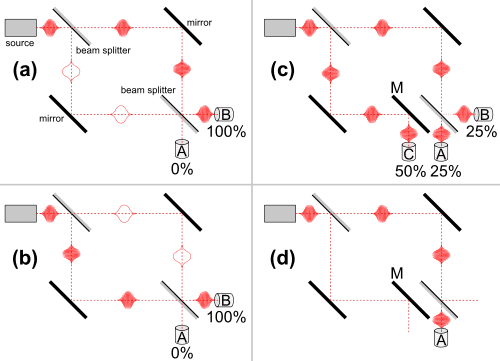
I'm trying to make a "Mach–Zehnder interferometer", that would show a same-named paradox.

In plain words:
Two half-silvered mirrors, two full mirrors, the beam is split, then merged together.
At the merge point one way the photon is canceled out, while the other way it is combined.
So, we should see only one beam, specifically one parallel to the incoming beam.
Furthermore, breaking one of the split beams should produce two beams at the output.

That is, this:
500px-Mach-Zender_interferometer_paradox_%282%29.svg.png


However, trying to make this in a naive way produced a total lack of anything unusual.
Basically, i used a laser diode, two beam splitters and two polished pieces of metal as mirrors.
After carefully aligning it all, i got two beams coming out of the combining beam splitter.

What it looks like: http://orbides.1gb.ru/img/interfer.jpg

The question is: What have i missed or done wrong?
Is it a matter of precision, or something is fundamentally wrong?
 
Physics news on Phys.org
Several things come to my mind.

First, the visibility of the interference pattern depends on the path difference between the two paths. The interference will vanish if the path difference times the speed of light becomes comparable to the coherence time of your light source. Therefore one needs to check the path lengths very carefully.

Second, the interference pattern depends on the relative phase of the two beams at the combining beam splitter (which in turn depends again on the length difference between the two paths). You get all the intensity at detector A at relative phase 0, all the intensity at detector B at relative phase pi and everything in between at every possible phase in between. The phase depends critically on the path length. A path length difference equal to the wavelength of the light already corresponds to a 2 pi phase shift, so to get a well defined interference pattern where all the intensity just goes to one detector, you need to be able to control the path length difference with an accuracy of few nanometers or better. Usually this is achieved by mounting one of the mirrors on a linear piezo actuator which allows precise positioning.
 

Similar threads

  • · Replies 17 ·
Replies
17
Views
2K
  • · Replies 33 ·
2
Replies
33
Views
3K
  • · Replies 5 ·
Replies
5
Views
4K
  • · Replies 13 ·
Replies
13
Views
2K
  • · Replies 10 ·
Replies
10
Views
3K
  • · Replies 8 ·
Replies
8
Views
3K
  • · Replies 28 ·
Replies
28
Views
4K
  • · Replies 7 ·
Replies
7
Views
3K
  • · Replies 2 ·
Replies
2
Views
4K
  • · Replies 5 ·
Replies
5
Views
3K