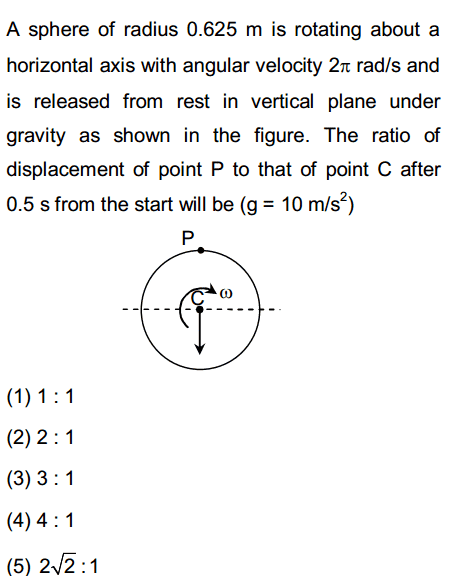
Falling rotating sphere and displacements

Click For Summary
SUMMARY

The discussion focuses on calculating the displacements of points P and C on a falling rotating sphere after 0.5 seconds. The solution involves determining the centripetal acceleration and using the equation for free-falling bodies to compute the displacement of point C. For point P, the angle is calculated using the angular velocity, which is given as π radians per second, leading to a displacement of 2r (1.25 m). The final ratio of displacements between points P and C is established as 2:1, accounting for the sphere's rotation.

PREREQUISITES
  • Understanding of centripetal acceleration
  • Knowledge of angular velocity and its application
  • Familiarity with free-fall equations
  • Basic principles of rotational motion
NEXT STEPS
  • Study the equations of motion for free-falling bodies
  • Learn about centripetal acceleration in rotating systems
  • Explore angular displacement calculations using angular velocity
  • Investigate the effects of rotation on displacement in physics
USEFUL FOR

Students studying physics, particularly those focusing on mechanics, as well as educators and tutors looking to enhance their understanding of rotational motion and displacement calculations.

LoveBoy
Messages
44
Reaction score
1

Homework Statement


proxy.php?image=http%3A%2F%2Fi.imgur.com%2FN04l7ru.png


Homework Equations


How to locate the point P and C after 0.5s from their initial position ?

The Attempt at a Solution


Well i don't know whether it would be correct way to start the problem i.e find the centripetal acceleration .
 
Physics news on Phys.org
You can find how far C moves in 0.5 sec, since it is the centre of gravity of the sphere.
So you know the two positions of the sphere and where P is at each position.
Then simply work out PP' and CC' and find the ratio.
 
To compute for the displacement of point C use the equation for free falling bodies. As for point P, compute for the angle using the angular velocity and you will find that it has traveled all the way to the other side of the sphere (be careful here as you are dealing with displacement, not total distance). With that you should be able to get the ratio.
 
As C is in free fall condition,so
0Vs5NZr.png

rickz02 said:
As for point P, compute for the angle using the angular velocity and you will find that it has traveled all the way to the other side of the sphere (be careful here as you are dealing with displacement, not total distance).
How to find angle using angular velocity ?
 
distance = velocity x time so angle = angular velocity x time

You can work that out from the question, because the angular velocity is given as radians per second. So if you multiply it by seconds, you will get radians.

PS. They've given a really easy angular velocity.
 
i got π radians.
So, displacement of point P would be 2r=1.25 m
 
086qjac.png
 
I think you're forgetting that as P rotates round the sphere, the whole sphere is moving down.
If the sphere were not rotating, P would move the same distance as C (1:1), but the rotation adds to the displacement of P.
 
  • #10
Okay.
So answer would be 2:1.
 
  • #11

Similar threads

  • · Replies 71 ·
3
Replies
71
Views
4K
Replies
15
Views
2K
Replies
7
Views
2K
  • · Replies 39 ·
2
Replies
39
Views
3K
Replies
1
Views
820
  • · Replies 19 ·
Replies
19
Views
4K
Replies
2
Views
2K
Replies
2
Views
2K
Replies
335
Views
16K
Replies
18
Views
2K