Fan Selection for air cooling of a computer

Click For Summary
SUMMARY

The discussion focuses on the principles of air flow in fan selection for computer cooling, specifically addressing the assumptions made in a textbook regarding velocities at points P3 and P4. It is established that the velocities are assumed to be equal due to the constant tube diameter and the in-compressible nature of the fluid, which maintains constant mass flow. The conversation also highlights that while fans primarily change pressure through work, the design of the intake tube influences air acceleration and flow characteristics.

PREREQUISITES
  • Understanding of fluid dynamics principles, particularly in-compressible flow.
  • Familiarity with fan performance characteristics and pressure-volume relationships.
  • Knowledge of basic thermodynamics related to energy transfer in fluid systems.
  • Ability to interpret diagrams related to airflow and pressure changes in ducts.
NEXT STEPS
  • Research the Bernoulli's equation and its application in fan design.
  • Study the effects of duct shape on airflow dynamics and pressure changes.
  • Explore fan performance curves and how they relate to system resistance.
  • Learn about computational fluid dynamics (CFD) simulations for airflow analysis.
USEFUL FOR

This discussion is beneficial for mechanical engineers, HVAC professionals, and computer hardware designers who are involved in optimizing air cooling solutions for electronic systems.

mech-eng
Messages
825
Reaction score
13
Moved from a technical forum, so homework template missing
I 90% understand the question and solution but unfortunately I have some hesitations about the formal solution in the book.
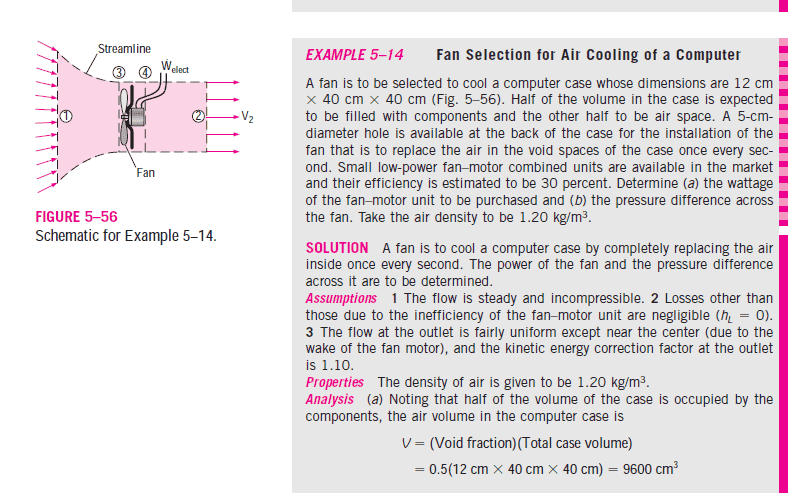
fan select.png

fan select 2.png


First of all, when calculating P4-P3, choosing lines and points on them, why do book assume velocities of 3 and 4 to be the same?

http://opencourses.emu.edu.tr/pluginfile.php/4500/mod_resource/content/1/Chapter5.pdf

Thank you.
 
Physics news on Phys.org
I'm not familiar with the equations, but at point 3 the air will be sucked in at some velocity 'v' and just at 4 it will be pushed out at the same velocity 'v' excluding any energy losses.
 
mech-eng said:
why does book assume velocities of 3 and 4 to be the same?
Because the tube diameter is constant between 3 and 4, and assuming in-compressible fluid, the density does not change. Mass flow is constant or else mass would be accumulating. So from point 4 to the end of the exhaust tube, velocity and pressure ideally remain constant. Afterwards, the pressure would normally decrease and velocity would increase, affected by viscous reaction with the surrounding air.
 
  • Like
Likes   Reactions: CivilSigma
Can we say as one consequence that when fans sucking airs, they just change their pressures at first by fan work?

Thank you.
 
mech-eng said:
Can we say as one consequence that when fans sucking airs, they just change their pressures at first by fan work?
Looking at the diagram, the funnel shaped tube intake would correspond to accelerating air. Within the cylindrical part of the tube, there would be no net acceleration in the direction of the tube.
 
Last edited:
rcgldr said:
Looking at the diagram, the funnel shaped tube intake would correspond to accelerating air. Within the cylindrical part of the tube, there would be no next acceleration in the direction of the tube.

Yes, this can be another result from directly looking the scheme but what about deriving a result for pressures?

Thank you.
 

Similar threads

Replies
24
Views
3K
  • · Replies 5 ·
Replies
5
Views
5K
  • · Replies 7 ·
Replies
7
Views
3K
  • · Replies 7 ·
Replies
7
Views
4K
  • · Replies 7 ·
Replies
7
Views
4K
  • · Replies 6 ·
Replies
6
Views
5K
  • · Replies 9 ·
Replies
9
Views
4K
  • · Replies 1 ·
Replies
1
Views
4K
  • · Replies 1 ·
Replies
1
Views
3K
  • · Replies 1 ·
Replies
1
Views
4K