FAQs about Bobrick & Martire's Warp Drive & Lentz's Paper

  • Context: High School 
  • Thread starter Thread starter rgtr
  • Start date Start date
  • Tags Tags
    Warp
Click For Summary
SUMMARY

The discussion centers on the feasibility of warp drives as proposed by Bobrick and Martire, and the critiques presented in Lentz's paper. Key points include the necessity of negative energy density for warp drives, which has not been observed and is considered non-physical. The conversation highlights that both Bobrick et al. and Lentz's claims regarding energy conditions are refuted, particularly emphasizing the need for a complete computation of the Einstein tensor to validate their assertions. The consensus is that current scientific understanding indicates warp drives require exotic matter, making their practical realization highly questionable.

PREREQUISITES
  • Understanding of general relativity and its implications on spacetime geometries.
  • Familiarity with the concept of energy conditions in theoretical physics.
  • Knowledge of negative energy density and its role in warp drive theories.
  • Basic comprehension of the Einstein tensor and its components.
NEXT STEPS
  • Research the implications of negative energy density in theoretical physics.
  • Study the Einstein tensor and its full computation in the context of warp drives.
  • Examine the critiques of Lentz's paper as presented by Visser et al.
  • Explore recent advancements in warp drive theories and the role of exotic matter.
USEFUL FOR

The discussion is beneficial for theoretical physicists, researchers in general relativity, and anyone interested in the scientific viability of warp drive concepts and the associated energy conditions.

rgtr
Messages
90
Reaction score
8
TL;DR
I have a few layman's questions about warp drives.
Bobrick and Martire's warp drive.
https://arxiv.org/abs/2102.06824
Lentz's paper.
https://arxiv.org/abs/2006.07125
1635564586615.png


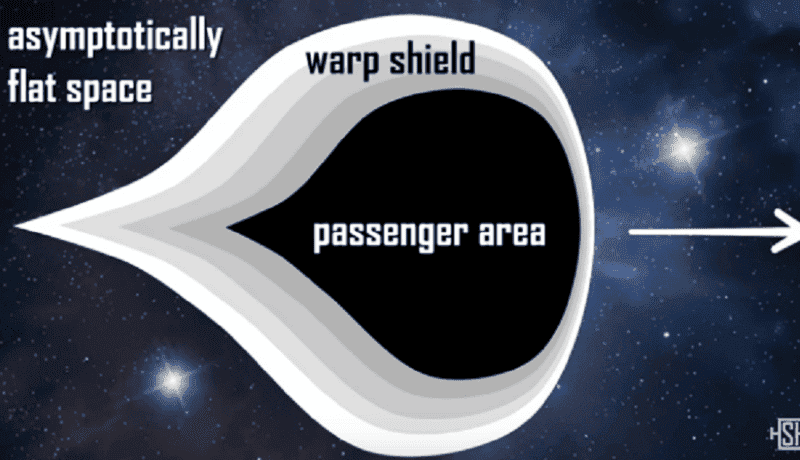
Is the warp shield the bending of space in the warp drive?What feeds energy into the system to accelerate? I mean can a planet accelerating be equivalent to a rocket engine accelerating to power the warp drive? In a warp drive in order to speed up do you need a to feed in energy?
what is the warp shield made of? I mean is it man made or created by nature?How does any of this relate to Erik lentz paper and my question?In Lentz paper can the warp shield be created by nature or is it man made? In Lentz paper can you accelerate faster then light?By shrinking the passenger area do you need less energy to go faster?
 
Physics news on Phys.org
  • Like
Likes   Reactions: PeterDonis
PAllen said:
Both papers you cite are thoroughly refuted here
To be more precise, the claims in the papers cited in the OP that energy conditions are not violated, so that such spacetime geometries might actually be feasible to realize, are refuted.
 
Just to confirm you are saying "spacetime geometries might actually be feasible to realize, are refuted." because the energy conditions are violated. Is this correct? Do you have a simple definition of energy conditions that warp drives violate? I do not understand the definitions of energy conditions that I found online. Thanks.
 
rgtr said:
Do you have a simple definition of energy conditions that warp drives violate?
It means that the warp drive can only be made out of material that has a negative energy density. By ##E=mc^2## that means it would have a negative mass. If you were to push it to the left it would accelerate to the right.

Such material has never been observed and most likely would not be able to be stable. So generally solutions requiring this sort of exotic matter are considered non-physical.
 
There seems to be insufficient knowledge that if it were possible to create a macroscopic body violating the dominant energy condition, such a body could simply move on a spacelike trajectory, (I.e. FTL) without need to bother with wormholes or warp drives. This also means ‘a baseball’ of such material could be thrown into the past by two cooperating observers via the tachyonic anti-telephone method.

See, for example:

https://arxiv.org/abs/1106.2336

and more recent work by Weatherall and Geroch that even more generally establishes that there is no expectation (in general relativity) that a small body moves on timelike geodesics unless the dominant energy condition is satisfied.
 
  • Like
Likes   Reactions: PeroK and PeterDonis
PAllen said:
more recent work by Weatherall and Geroch that even more generally establishes that there is no expectation (in general relativity) that a small body moves on timelike geodesics unless the dominant energy condition is satisfied.
I find it interesting that in this paper, it's not even the standard dominant energy condition that is shown to be necessary, but a "strengthened" dominant energy condition, which includes the requirement that, basically, the 4-momentum of a piece of matter has to be timelike. In other words, it's almost putting in by hand the fact that small bodies move on timelike worldlines.
 
PeterDonis said:
I find it interesting that in this paper, it's not even the standard dominant energy condition that is shown to be necessary, but a "strengthened" dominant energy condition, which includes the requirement that, basically, the 4-momentum of a piece of matter has to be timelike. In other words, it's almost putting in by hand the fact that small bodies move on timelike worldlines.
I haven’t had a chance to look at these much, but these newer collaborative papers of Weatherall and Geroch seem to be able to use the ordinary dominant energy condition via a new method they introduce (tracking). This means many different lines of research (e.g. Gralla and Wald, as well) converge on the idea that timelike motion of bodies is simply not mandated by GR without the dominant energy condition.

https://arxiv.org/abs/1810.09046

https://arxiv.org/abs/1707.04222
 
Last edited:
  • Like
Likes   Reactions: PeterDonis
Sorry for the repetitive question but according to current science warp drives need negative energy even slower then light warp drives? Do you think it would ever be possible to create a positive mass warp drive?
 
  • #10
rgtr said:
Sorry for the repetitive question but according to current science warp drives need negative energy even slower then light warp drives? Do you think it would ever be possible to create a positive mass warp drive?
I believe the main complaint by Visser et.al. against Bobrick et.al. is that they don't compute the whole Einstein tensor; mostly they just compute the 00 component of it. This is simply insufficient to make any claims about satisfying an energy condition. Thus, I would say it is simply an open question whether a subluminal warp drive with ordinary matter is possible - it very well may be, but the Bobrick et.al. analysis on this point is incomplete per Visser et.al. Both of these papers actually agree that exotic matter (matter that could move superluminally by itself) is required for superluminal warp drives.
 
  • #11
PAllen said:
I believe the main complaint by Visser et.al. against Bobrick et.al. is that they don't compute the whole Einstein tensor; mostly they just compute the 00 component of it. This is simply insufficient to make any claims about satisfying an energy condition. Thus, I would say it is simply an open question whether a subluminal warp drive with ordinary matter is possible - it very well may be, but the Bobrick et.al. analysis on this point is incomplete per Visser et.al. Both of these papers actually agree that exotic matter (matter that could move superluminally by itself) is required for superluminal warp drives.
So why hasn't someone calculated or computed all the components of the tensor? Also how does this relate to Lentz paper?
 
  • #12
rgtr said:
So why hasn't someone calculated or computed all the components of the tensor? Also how does this relate to Lentz paper?
The Lentz paper is simply bogus, per Visser et.al. analysis. Its primary claims about energy conditions are just false.

Why hasn't anyone computed all the components? Visser et.al. have no particular interest in doing so (I would guess). Bobrick et.al. might get around to it in a future paper. But who knows? It is not a simple undertaking.
 

Similar threads

  • · Replies 4 ·
Replies
4
Views
2K
  • · Replies 15 ·
Replies
15
Views
3K
  • · Replies 1 ·
Replies
1
Views
3K
  • · Replies 2 ·
Replies
2
Views
2K
  • · Replies 15 ·
Replies
15
Views
4K
  • · Replies 2 ·
Replies
2
Views
3K
Replies
4
Views
4K
  • · Replies 2 ·
Replies
2
Views
5K
  • · Replies 12 ·
Replies
12
Views
5K
  • · Replies 2 ·
Replies
2
Views
3K