FBDs of Stacked Boxes: Understanding Force Distribution in Connected Objects

  • Thread starter Thread starter InvisibleMan1
  • Start date Start date
Click For Summary
SUMMARY

The discussion focuses on drawing Free Body Diagrams (FBDs) for two stacked boxes to understand force distribution. The user successfully applies Newton's third law to analyze the forces acting on both boxes, identifying the gravitational forces and the reaction forces between the boxes and the ground. The key takeaway is that Box A exerts a downward force on Box B, which in turn exerts an upward force on Box A, while the ground must support both boxes' combined weight. This understanding clarifies the interaction of forces in a stacked system.

PREREQUISITES
  • Newton's Third Law of Motion
  • Free Body Diagram (FBD) construction
  • Basic concepts of gravitational force
  • Understanding of reaction forces
NEXT STEPS
  • Study advanced applications of Newton's laws in multi-body systems
  • Learn about static equilibrium and its implications in force distribution
  • Explore graphical methods for solving complex FBDs
  • Investigate the effects of friction in stacked object scenarios
USEFUL FOR

Students in physics, engineers dealing with structural analysis, and anyone interested in understanding force interactions in stacked systems will benefit from this discussion.

InvisibleMan1
Messages
40
Reaction score
0
To help me understand how a force is distributed over multiple connected objects, I have been trying to draw the FBDs of two stacked boxes which are sitting on the ground. I haven't been able to solve the problem however, and looking for the solution with Google did not turn up anything useful. I'm aware of Newton's third law, but I still have not been able to solve this... I'm at a loss, which is why I am posting here.

Here is an image of the problem:
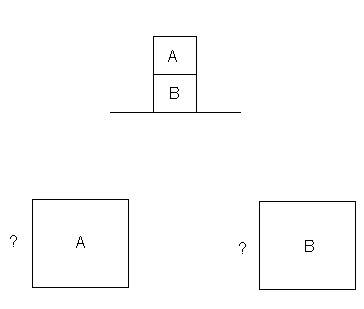
fbd_problem.jpg


One attempt at solving it using Newton's third law ended up as (what appeared to be) an infinite loop of action-and-reaction forces going up and down the stack. I tried thinking of the two objects as a single object, but that just ended in guesswork without anything real concrete.

What would the FBD of A and the FBD of B look like, with all involved forces?
 
Physics news on Phys.org
So A and B each feel a gravitational force (also resultant in reactionate forces meaning you have to draw two upward vectors in the Earth's core, but i think we're ignoring them here). Since A is not moving, it has to experience an equal (in magnitude) force upward: this can only come from B, and this force's reactionate brother is the force B experiences from A, the latter obviously pushing down. This force makes B extra heavy and thus the ground under B must deliver a force not only for B itself, but also the load B is carrying (this is indirectly what allows B to hold A up in its place). This last force from the ground to B also has a reactionate brother pushing from the blocks onto the ground (which is the force that would make for a weighing scale placed under B to react)

I hope this helps?
 
That solved the problem, thanks :)
 

Similar threads

  • · Replies 5 ·
Replies
5
Views
2K
  • · Replies 5 ·
Replies
5
Views
2K
  • · Replies 5 ·
Replies
5
Views
4K
  • · Replies 10 ·
Replies
10
Views
5K
Replies
5
Views
2K
  • · Replies 5 ·
Replies
5
Views
2K
  • · Replies 8 ·
Replies
8
Views
1K
Replies
7
Views
2K
  • · Replies 3 ·
Replies
3
Views
5K
  • · Replies 7 ·
Replies
7
Views
2K