s_hy
- 57
- 0
hi all,
i have wrote codes for 2d fdtd in different permittivity (epsilon). in this code, cell size is 200 x 200, start with eps=1 from center, and different permittivity started at boundary (i1,i2) = (25,75) = (j1,j2), epsilon = 2. the problem is, when the wave propagates and approach (i1,i2) = (25,75) = (j1,j2), i have detected some reflections happened to the wave at timesteps, n after 50, the reflections become obvious...i just wondering, why is that happened. i attached here the animation of the wave and my codes. i really have no idea how to solve this problem.
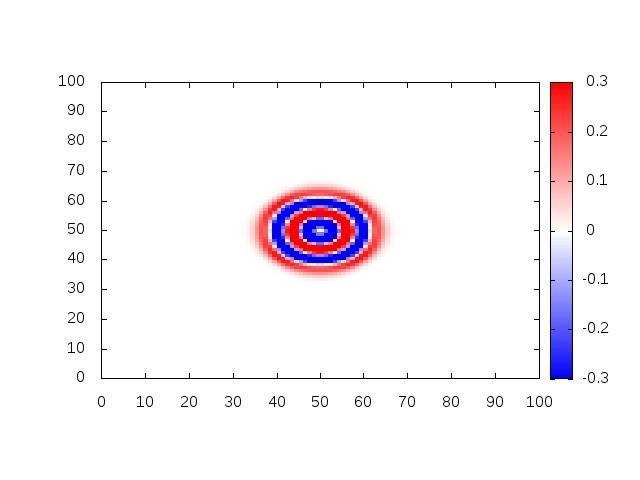
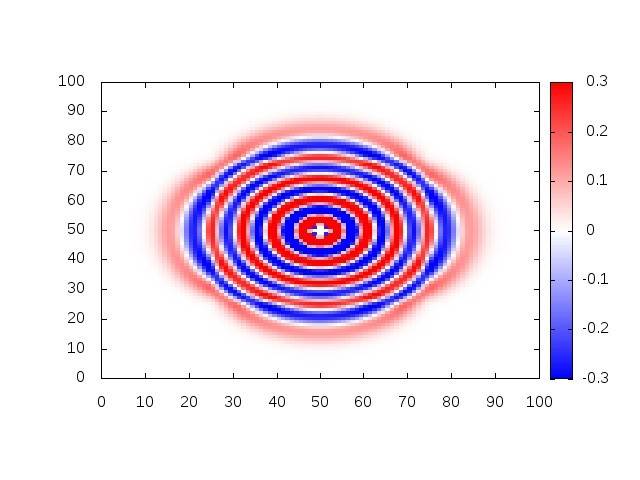
i have wrote codes for 2d fdtd in different permittivity (epsilon). in this code, cell size is 200 x 200, start with eps=1 from center, and different permittivity started at boundary (i1,i2) = (25,75) = (j1,j2), epsilon = 2. the problem is, when the wave propagates and approach (i1,i2) = (25,75) = (j1,j2), i have detected some reflections happened to the wave at timesteps, n after 50, the reflections become obvious...i just wondering, why is that happened. i attached here the animation of the wave and my codes. i really have no idea how to solve this problem.
Code:
subroutine test7
implicit none

double precision                                     :: f0,A0
double precision                                     :: delta, deltat
double precision                                     :: eps0,epsr,miu0,miur
double precision                                     :: lamda
double precision                                     :: omega
double precision                                     :: S,k,c
integer                                                     :: i,j
integer                                                     :: ie,je,ic,jc,i1,i2,j1,j2
integer                                                     :: n
double precision,dimension(202,202)   :: Ez,Hy,Hx
double precision,dimension(202,202)   :: Ca,Cb,Da,Db,Dax,Dbx,Day,Dby
!double precision                                     :: Ca,Cb,Da,Db
double precision,dimension(202,202)   :: miu,eps,sigma, sigmat
double precision, parameter                 :: pi = 3.14159265
character(len=20)                                   :: filename

! parameters
 f0 = 3.0e7
 eps0 = 8.8e-12
 miu0 =  4*pi*1e-7
 c = 3.e8
 lamda = c/f0
 omega = 2*pi*f0
 print *, 'lamda=',lamda
 A0 = 5.0
 k = 2*pi / lamda
 omega = c*k

!courant stability factor
 !S = 1/sqrt(2.0)
! spatial and time grid steps
 delta = lamda/10
 deltat = delta/(2*c)
 print *, 'deltat=',deltat

!model size
 ie = 100
 je = 100

 !source location
 ic = ie/2
 jc = je/2

 !boundary for different permittivity
 i1 = ie/4
 i2 = ie*3/4
 j1 = je/4
 j2 = je*3/4

print*, 'see me?'

!initialize Ez, Hx,Hy to zero at t=0
do i = 1,ie
 do j = 1,je
   Hx(i,j) = 0.0
   Hy(i,j) = 0.0
   Ez(i,j) = 0.0
 end do
end do


!medium's properties
 miur = 1.0
 epsr = 1.0

  do i = 1,ie
   do j = 1,je
     !initialize permittivity and permeability
     eps(i,j) = epsr*eps0
     miu(i,j) = miur*miu0
   end do
  end do

  do i = i1,i2
    do j = j1,j2
     eps(i,j) = 2*eps0
     miu(i,j) = 1*miu0
    end do
 end do

  !medium's properties
! initialize electric conductivity & magnetic conductivity
  do i = 1,ie
   do j = 1,je
     sigma(i,j) = 0.0
     sigmat(i,j) = 0.0
     Ca(i,j) = (2*eps(i,j)-deltat*sigma(i,j))/(2*eps(i,j)+deltat*sigma(i,j))
     Cb(i,j) = (2*deltat)/(2*eps(i,j)+deltat*sigma(i,j))
     Da(i,j) = (2*miu(i,j)-deltat*sigmat(i,j))/(2*miu(i,j)+deltat*sigmat(i,j))
     Db(i,j) = (2*deltat)/(2*miu(i,j)+deltat*sigmat(i,j))
   end do
  end do


! beginning of timesteps
 do n = 1,300

  write (filename, "('data',I3.3,'.dat')") n
  open (unit=130,file=filename)


!initiate sinusoidal wavepulse at center
  Ez(ic,jc) = A0*sin(2*pi*f0*n*deltat)

! calculate ez-field
  do i = 2,ie-1
    do j = 2,je-1
          Ez(i,j) = Ca(i,j)*Ez(i,j) + Cb(i,j)*(Hy(i,j) - Hy(i-1,j) - Hx(i,j) + Hx(i,j-1))
          write (130,*) i,j,Ez(i,j)
          if (j == 99) write (130,*) ' '
!          !print *,'i=',i,'j=',j,'Ez(i,j)=',Ez(i,j)
    end do
  end do

  do i = 1,ie-1
    do j = 1,je-1
	  Hx(i,j) = Da(i,j)*Hx(i,j) + Db(i,j)*(Ez(i,j) - Ez(i,j+1))
          !print *,'i=',i,'j=',j,'Hx(i,j)=',Hx(i,j)
     end do
  end do

    do i = 1,ie-1
     do j = 1,je-1
          Hy(i,j) = Da(i,j)*Hy(i,j) + Db(i,j)*(Ez(i+1,j) - Ez(i,j))
          !print *,'i=',i,'j=',j,'Hy(i,j)=',Hy(i,j)
     end do
  end do

close (unit=130)

end do !n

end SUBROUTINE test7