FEA Results interpretation for these 3 simulations

Click For Summary

Discussion Overview

The discussion revolves around the interpretation of Finite Element Analysis (FEA) results for three different structural simulations. Participants are analyzing potential points of failure in each structure based on stress distribution indicated in the FEA diagrams, while also questioning the accuracy of these interpretations without accompanying data.

Discussion Character

  • Exploratory
  • Technical explanation
  • Debate/contested

Main Points Raised

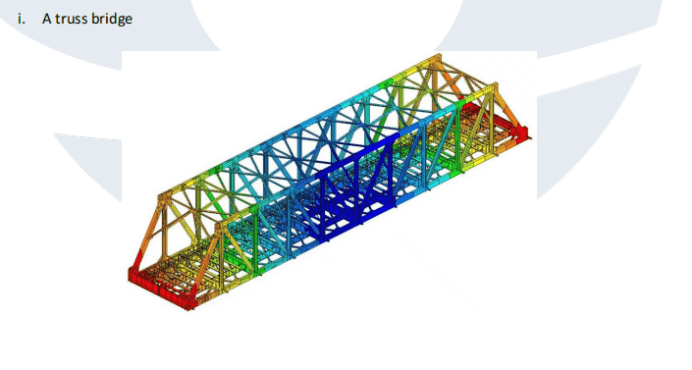
  • One participant suggests that the first point of failure in a truss bridge is likely at the center, despite the FEA showing high stress at the ends, arguing that concentrated stresses and loading will likely lead to fatigue in the beam.
  • Another participant questions this interpretation, pointing out the discrepancy between the FEA results and the proposed failure point, and challenges the reasoning behind the stress distribution at the ends of the bridge.
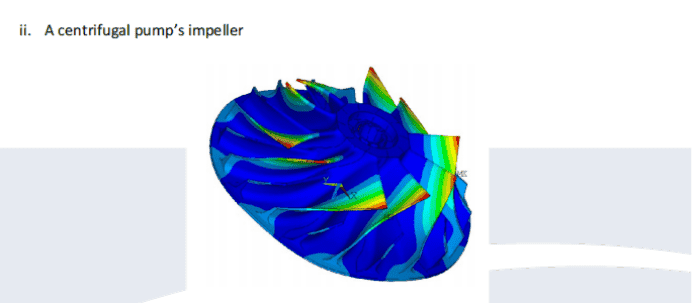
  • For the impeller blades, a participant proposes that failure is likely at the blades due to their thinness and susceptibility to vibration, while another suggests that failure might typically occur mid-way along the vanes instead of just at the tips.
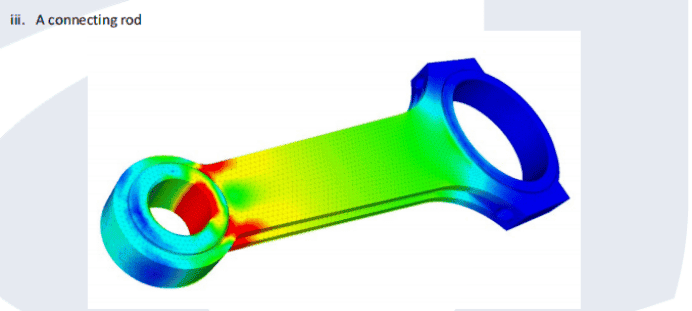
  • In the case of the piston connecting rod, one participant agrees with the stress distribution but asks for clarification on why the stress is concentrated in a specific area rather than at the top.
  • Several participants express uncertainty about the accuracy of the FEA results, particularly in the absence of data, and discuss the implications of assuming evenly distributed loads across the structures.
  • One participant emphasizes the importance of knowing boundary conditions and loads when interpreting FEA results, cautioning against drawing conclusions based solely on visual representations.

Areas of Agreement / Disagreement

Participants do not reach a consensus on the interpretation of the FEA results. There are multiple competing views regarding the points of failure in the structures, and the accuracy of the FEA diagrams is debated without a clear resolution.

Contextual Notes

Participants note limitations in their analysis due to the lack of data, boundary conditions, and specific loading information, which affects their ability to accurately interpret the FEA results.

Smushiehippo
Messages
10
Reaction score
0
Homework Statement
Explain where the first point of failure is likely to originate, and why.

An analysis of the studies, do you think that they will be an accurate representation of what will happen in practice?
Relevant Equations
none
Hi

Im slightly stuck not sure what i put is ok.

FEA was used to carry out analysis on 3 structures and diagram results obtain (no data)
Explain where the first point of failure is likely to originate, and why.
An analysis of the studies, do you think that they will be an accurate representation of what will happen in practice?

Red indicates high stress and blue indicates low stress

For the (i) there is high stress at both ends and low stress in center. I believe 1st point of failure would be at centre (blue area) and not indicated on diagram of high stress (red). Trusses support the bridge and take the majority of the load and stresses. Blue section centre of the bridge and where load and stress will be most concentrated. contentrated stresses and loading will likely fatigue in beam.

For the (ii) there is high stress at each blade and low stress at the base. I believe 1st point of failure would be at blade (red). Impeller blade are the thinest point on the structure. strength in this area is lowest compared to base. excess high vibration could lead to fatigue and first point of failure.

For the (iii) there is high close to the small end and low stress in big end. I believe 1st point of failure would be at small end (red). connecting rod under goes compression and tension in operation. high speed causing high rpm lead to stretching of the rod leading to failure.

Im stuck on comparing accurcy. I believe (i) is inaccurate but (ii and iii) are accurate. how do i compare accuracy with only pics and no data. im not 100% what each pic is showing, eg compression, tension, deformation.
1678042693120.png

1678042714293.png

1678042740506.png
 
Physics news on Phys.org
Since you haven't gotten any replies yet, I'll chime in with a couple thoughts/questions:

i) You say that you think the center of the truss bridge would be prone to fail first, but the FEA simulation shows blue in the middle and red at the supporting ends of the bridge. How do you reconcile that? Also, the red horizonal members at the two supporting ends look wrong to me, depending on how the ends are supported by the banks/ground. I can see why the vertical members at the end would be red, since they are supporting all of the weight of the bridge where it attaches to the ground, but I don't see a source of stress for the horizontal members on the ground at the ends.

ii) I don't know much about pump impellers, but it seems like a more typical failure would be for most of a vane to break off mid-way, not just at the tip. But I could be wrong about that.

ii) That looks like a reasonable stress distribution for the piston connecting rod. Can you say why the red area is where it is, and not at the top? What about a piston connecting rod might cause more stress in that area versus the opposite side of the piston pin?

1678482222966.png
 
So, is this assignment about sanity checking FEA results?
 
erobz said:
So, is this assignment about sanity checking FEA results?
pretty much checking.

Im doing online, so on my own working through this.

only given pic and with the question is do you think that they will be an accurate representation of what will happen in practice?

no data or notes, or info to read on it.

looking through a source i saw that ti said FEA red means high stress and blue low. other than that vary hard to find truss bridges FEA results with stress.

was guessing max bending motion would be in center so max stress would be as well and that lowest stress would be on the ends. there would more stresses on top than bottom of the beams. so diagram is not accurate. persumption that is evenly loaded across the bridge.
 
Smushiehippo said:
looking through a source i saw that ti said FEA red means high stress and blue low. other than that vary hard to find truss bridges FEA results with stress.
ok
Smushiehippo said:
was guessing max bending motion would be in center so max stress would be as well and that lowest stress would be on the ends. there would more stresses on top than bottom of the beams. so diagram is not accurate. persumption that is evenly loaded across the bridge.
If it was evenly distributed load, we should see symmetric stress distributions across the mid planes?
 
erobz said:
ok

If it was evenly distributed load, we should see symmetric stress distributions across the mid planes?
Looking at past examples of failure in truss bridges, high has been recorded at ends of bridges where failure happened in chord of truss.

With out info of loading or anything. I just don't know on the diagram.
 
Smushiehippo said:
Looking at past examples of failure in truss bridges, high has been recorded at ends of bridges where failure happened in chord of truss.

With out info of loading or anything. I just don't know on the diagram.
What I'm saying is that the loading seems to be asymmetric. Going across the bridge, as you would traverse it stresses appear symmetric, but the dark blue stress zone isn't mirrored in the opposite truss.

I'm probably out of my depth of understanding.
 
Interpretation of FEA results based only on colorful images is not the way to go. You should know at least the boundary conditions and loads plus, of course, actual values of output variables and properly scaled deformed shape. Otherwise, you may conclude that red is always bad and blue is always fine which is not true. Results should be always compared with allowable values. Apart from that, the first part of this task comes down to saying where red areas are located on each model which is obvious. The second one requires guessing how a component can be loaded and constrained. Instead of trying to interpret those images lacking any context, I would strongly suggest you download geometries like this from GrabCAD and run your own analyses in any FEA software, even open-source if you don't have a license for a commercial solution. You will learn so much more this way.
 
  • Like
Likes   Reactions: berkeman, Lnewqban, erobz and 1 other person

Similar threads

  • · Replies 3 ·
Replies
3
Views
2K
  • · Replies 3 ·
Replies
3
Views
2K
  • · Replies 9 ·
Replies
9
Views
3K
Replies
8
Views
4K
  • · Replies 100 ·
4
Replies
100
Views
10K
  • · Replies 9 ·
Replies
9
Views
4K
  • · Replies 13 ·
Replies
13
Views
7K
  • · Replies 11 ·
Replies
11
Views
4K
  • · Replies 21 ·
Replies
21
Views
5K
  • · Replies 15 ·
Replies
15
Views
6K