Fermi Surface squashed by potentials

Click For Summary
The discussion centers on the behavior of the Fermi surface in relation to potentials and the Brillouin zone (BZ) boundaries. It explains that a half-filled Brillouin zone with one valence electron and two spin states leads to energy gaps opening at the zone boundaries, causing states near these boundaries to be pushed down in energy. This results in a shift of the Fermi surface to higher k values, contradicting initial assumptions about it being squashed inward. The conversation also touches on how stronger potentials can cause the Fermi surface to protrude into the second Brillouin zone. Ultimately, the Fermi surface represents a surface of constant energy, which is reached at higher k values due to the energy level splitting caused by perturbations.
unscientific
Messages
1,728
Reaction score
13
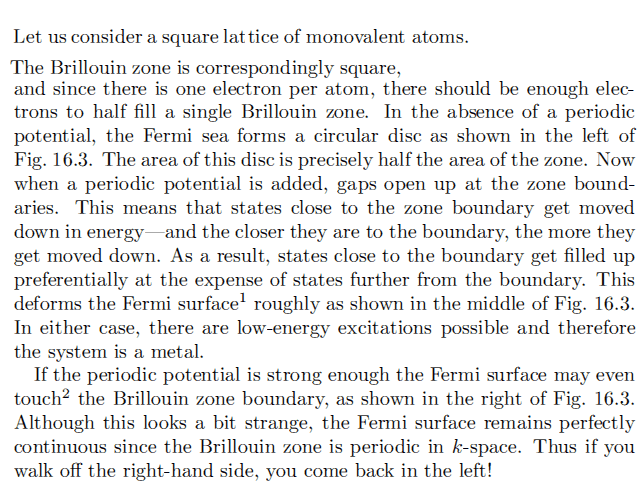
Taken from my textbook:

fermisea1.png


My understanding is that:

  • One valence electron, 2 spin states -> Half-filled Brillouin zone
  • Seeking inspiration from "Nearly Free Electron Model": gaps open up at zone boundaries
  • States nearer to zone boundaries get pushed down in energy further

Since a fermi surface is a surface of constant energy in k-space, shouldn't the surfaces nearer to the zone boundaries that get pushed down in energies get repelled even more? It seems that surfaces nearer to the boundaries get closer even! Why are the fermi seas like these below?
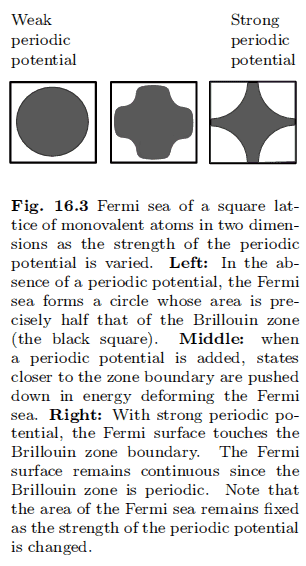
fermisea2.png
 
Physics news on Phys.org
Take a simple potential with this symmetry as an example: ##V(x,y)=A \cos(x)\cos(y)##. Can you find a direction along which the potential is constant? To which lines do these directions in reciprocal space? What happens at the cell boundary?
 
DrDu said:
Take a simple potential with this symmetry as an example: ##V(x,y)=A \cos(x)\cos(y)##. Can you find a direction along which the potential is constant? To which lines do these directions in reciprocal space? What happens at the cell boundary?
cosxcosy.png


The surfaces of constant potential are the circles* about (0,0). Given this is the fermi surface, these surfaces are the reciprocal space. Still doesn't answer my question about "pushed down in energy -> decrease in radius, squashed inwards"?
 
bumpp
 
Sorry, I was on the wrong track and had no time to think about your problem recently. Now I think I understand the behaviour. Near the BZ boundary, the lower energy band will be lowered as compared to the free electron case, so the Fermi surface will be shifted to higher k values. At stronger potentials, it will even protrude into the second BZ or even farther.
 
DrDu said:
Sorry, I was on the wrong track and had no time to think about your problem recently. Now I think I understand the behaviour. Near the BZ boundary, the lower energy band will be lowered as compared to the free electron case, so the Fermi surface will be shifted to higher k values. At stronger potentials, it will even protrude into the second BZ or even farther.

I get the downward shift in energy due to a perturbation. Why will the fermi surface be shifted to higher k values?
 
The fermi surface is a surface of constant energy. If the levels split, this constant energy value will be reached at higher values of k. Think of an irregularly shaped plate: where the rim is lower, soup will ooze out more.
 

Similar threads

  • · Replies 1 ·
Replies
1
Views
2K
  • · Replies 1 ·
Replies
1
Views
2K
  • · Replies 2 ·
Replies
2
Views
6K
  • · Replies 12 ·
Replies
12
Views
6K
  • · Replies 2 ·
Replies
2
Views
5K
  • · Replies 4 ·
Replies
4
Views
3K
  • · Replies 4 ·
Replies
4
Views
3K
  • · Replies 21 ·
Replies
21
Views
81K
  • · Replies 3 ·
Replies
3
Views
3K
  • · Replies 2 ·
Replies
2
Views
14K