Science Advisor
Gold Member
- 458
- 40
If one has a 4-fermion vertex, like in Fermi theory : ##G_f (f_1 \Gamma f_2)(l_1 \Gamma l_2)##
And you are calculating a one-loop diagram where you have the diagram of :
f1-> f2,l1,l2 -> f1
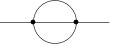
(used for dispersive/unitarity approach)
Where in the end you'll use Cutkosky rules to calculate it, but ignore this for now.
The question is about converting this diagram to an equation, which direction does one go? You can follow fermion flow backward through either of the two forward-arrow propagators, but then what. It matters as there is dirac algebra involved.
I assume it has to do with the order of the fermions in your actual interaction term, and when doing the time ordered product of two of these vertices you have to watch for fierz transforming the currents so that its manageable.
Is that correct, that I should approach this "diagram" without usign the diagram, but rather a product of currents, time-ordered, and do it the long way, fierz-transforming the spinor currents so that things simplify? Or is there a prescription for handing this case straight from the diagram.
It seems a feynman diagram is not enough to be honest for 4-fermion interactions of this sort, as the directions matter, and "going against particle flow" is not enough when you have choices. So you must either sum over all the paths, or do it by hand.
Any insight?
And you are calculating a one-loop diagram where you have the diagram of :
f1-> f2,l1,l2 -> f1
(used for dispersive/unitarity approach)
Where in the end you'll use Cutkosky rules to calculate it, but ignore this for now.
The question is about converting this diagram to an equation, which direction does one go? You can follow fermion flow backward through either of the two forward-arrow propagators, but then what. It matters as there is dirac algebra involved.
I assume it has to do with the order of the fermions in your actual interaction term, and when doing the time ordered product of two of these vertices you have to watch for fierz transforming the currents so that its manageable.
Is that correct, that I should approach this "diagram" without usign the diagram, but rather a product of currents, time-ordered, and do it the long way, fierz-transforming the spinor currents so that things simplify? Or is there a prescription for handing this case straight from the diagram.
It seems a feynman diagram is not enough to be honest for 4-fermion interactions of this sort, as the directions matter, and "going against particle flow" is not enough when you have choices. So you must either sum over all the paths, or do it by hand.
Any insight?