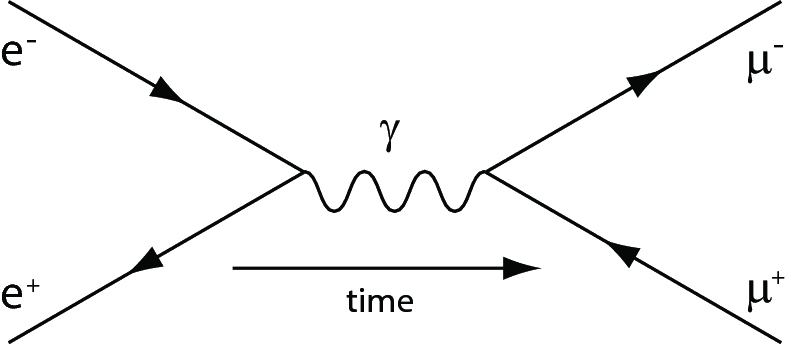
Feynman diagrams for ##e^{+}e^{-}\rightarrow \mu^{+}\mu^{-}##

Click For Summary
SUMMARY

The discussion centers on the electron-positron annihilation process into muons, represented by the Feynman diagram for the reaction $$e^{+}e^{-}\rightarrow \mu^{+}\mu^{-}$$. It is established that only s-channel diagrams are valid for this process due to lepton flavor conservation, which prohibits t-channel and u-channel diagrams in Quantum Electrodynamics (QED). The interaction term in the Lagrangian, $$\mathcal{L}_{\text{int}}=e (\overline{\psi}_e \gamma^{\mu} \psi_e + \overline{\psi}_{\mu} \gamma^{\mu} \psi_{\mu}) A_{\mu}$$, is crucial for understanding the Feynman rules governing these interactions. Additionally, the discussion touches on the impossibility of direct coupling between Dirac fermion fields due to lepton conservation, a fundamental principle in the Standard Model.

PREREQUISITES
  • Understanding of Feynman diagrams and their significance in particle physics.
  • Familiarity with Quantum Electrodynamics (QED) principles.
  • Knowledge of the Standard Model, particularly lepton conservation laws.
  • Basic grasp of Lagrangian mechanics and interaction terms in quantum field theory.
NEXT STEPS
  • Study the derivation and implications of the interaction term $$\mathcal{L}_{\text{int}}$$ in QED.
  • Explore the concept of lepton flavor conservation and its role in particle interactions.
  • Investigate effective field theories and their applications, particularly in four-fermion interactions.
  • Learn about the implications of Fermi's theory of beta decay in the context of particle physics.
USEFUL FOR

Particle physicists, theoretical physicists, and students studying quantum field theory who seek to deepen their understanding of particle interactions and conservation laws in the Standard Model.
spaghetti3451
Messages
1,311
Reaction score
31
Consider the process of electron-positron annihilation into muons as given by

$$e^{+}e^{-}\rightarrow \mu^{+}\mu^{-}.$$

The Feynman diagrams for this process to lowest-order are given by

eemm.png


This is an s-channel diagram.Why are there no t-channel or u-channel diagrams for this process?
 
Physics news on Phys.org
Well, try to draw ##t##- and ##u##-channel diagrams for QED. You'll see that they contradict the Feynman rules, because within QED flavor is conserved!
 
I see!

Can you explain this using the interaction term in the Lagrangian that describes this process?
 
The interaction terms read
$$\mathcal{L}_{\text{int}}=e (\overline{\psi}_e \gamma^{\mu} \psi_e + \overline{\psi}_{\mu} \gamma^{\mu} \psi_{\mu}) A_{\mu}.$$
Now find the Feynman rules for the vertices and compare them to what you'd need to be allowed to draw ##t##- and ##u##-channel Feynman diagrams for pair annihilation.
 
  • Like
Likes   Reactions: hilbert2 and spaghetti3451
vanhees71 said:
The interaction terms read
$$\mathcal{L}_{\text{int}}=e (\overline{\psi}_e \gamma^{\mu} \psi_e + \overline{\psi}_{\mu} \gamma^{\mu} \psi_{\mu}) A_{\mu}.$$
Now find the Feynman rules for the vertices and compare them to what you'd need to be allowed to draw ##t##- and ##u##-channel Feynman diagrams for pair annihilation.

Got it, thanks!
 
This thread made a related question come to my mind, and it's probably not necessary to start another thread for it... Is there some fundamental reason why two Dirac fermion fields are always coupled only through some intermediate bosonic field, and can't have a direct coupling? I.e. why can't there be an interaction term proportional to something like ##\overline{\psi_\mu}\psi_e## ? I know that the answer is probably something very simple, like that this would not be compatible with unitary time evolution or special relativity, but I'm an applied physicist by specialty, so it isn't immediately obvious to me.
 
You "can't have" such a coupling because of lepton conservation. It's an empirical input to the Standard Model.
 
  • Like
Likes   Reactions: hilbert2
vanhees71 said:
You "can't have" such a coupling because of lepton conservation. It's an empirical input to the Standard Model.

Thanks for the answer. I looked this up at Google and I only found vague mentions of four-fermion interactions happening in some effective field theories: https://en.wikipedia.org/wiki/Four-fermion_interactions

Maybe there's some way to combine the electron, positron, muon and antimuon fields in some term in a way that conserves net lepton numbers. Something like ##\overline{\psi}_{\mu} \psi_{e} \overline{\psi}_{e} \psi_{\mu}## ... But of course, no one has ever observed such interactions so I'm just playing with the math here.
 
You get such interactions in effective field theories by contracting the internal boson lines, if there is, e.g., a large mass in the corresponding propagator (as for the W and Z bosons). Then you get something like Fermi's theory of beta decay as an effective theory with (non-renormalizable) four-fermion couplings.
 
  • #10
Hilbert, what you wrote down corresponds to an electron bopping along and suddenly becoming a muon. Violates conservation of energy.
 
  • #11
^ Ok. I didn't bother to try to expand those point interaction terms with creation and annihilation operators. Obviously the interaction should only be able to turn an electron-positron pair with large kinetic energy to a muon-antimuon pair. Isn't the ##
\overline{\psi}_{\mu} \psi_{e} \overline{\psi}_{e} \psi_{\mu}## a bit similar to the phi-4 interaction for a single scalar field?
 

Similar threads

  • · Replies 6 ·
Replies
6
Views
2K
  • · Replies 0 ·
Replies
0
Views
1K
  • · Replies 2 ·
Replies
2
Views
2K
  • · Replies 1 ·
Replies
1
Views
2K
  • · Replies 6 ·
Replies
6
Views
5K
  • · Replies 4 ·
Replies
4
Views
3K
  • · Replies 80 ·
3
Replies
80
Views
5K
  • · Replies 1 ·
Replies
1
Views
1K
  • · Replies 5 ·
Replies
5
Views
3K
  • · Replies 3 ·
Replies
3
Views
2K