Understanding Neutron Star Formation Through Feynman Diagrams

Click For Summary

Discussion Overview

The discussion revolves around the formation of neutron stars and the use of Feynman diagrams to represent interactions during gravitational collapse, specifically the process where valence electrons combine with protons. Participants explore the implications of these diagrams in terms of particle interactions and the representation of time in the diagrams.

Discussion Character

  • Exploratory
  • Technical explanation
  • Conceptual clarification

Main Points Raised

  • One participant presents a Feynman diagram related to the interaction of protons and electrons leading to neutron formation, questioning which particle emits the W boson.
  • Another participant clarifies that neither the electron nor the up quark can be considered the "emitter" of the boson, as it is exchanged between the particles involved in the interaction.
  • A follow-up question is posed regarding the significance of the order of decay between the up quark and the electron in the diagram.
  • It is noted that the diagram does not specify the spacetime locations of the interaction vertices, and that this can be misleading in visual representations.
  • A participant emphasizes that the mathematical interpretation of the diagram corresponds to an infinite number of terms for possible spacetime locations of the vertices.

Areas of Agreement / Disagreement

Participants generally agree on the nature of the interaction represented in the Feynman diagram and the concept that neither particle can be definitively labeled as the emitter of the boson. However, there is an ongoing exploration of the implications of vertex placement and decay order, indicating some uncertainty in interpretation.

Contextual Notes

The discussion highlights limitations in visual representations of Feynman diagrams, particularly regarding their implications for spacetime and interaction order, which remain unresolved.

doggydan42
Messages
169
Reaction score
18
Hello,

I recently watched a video as an introduction to Feynman diagrams for my own self-interest. The video gave a link to practice problems, and one of them was as follows:

In a neutron star gravitational collapse causes valence electrons to combine with protons. Draw a Feynman diagram representing this interaction.
$$p+e^{-} \rightarrow n + \nu_e
\\ uud+e^{-} \rightarrow udd + \nu_e$$

I understood most of the interaction and that there would be a W+ boson between the up quark and electron, though would the electron or up quark emit the boson, and why?

Thank you in advance
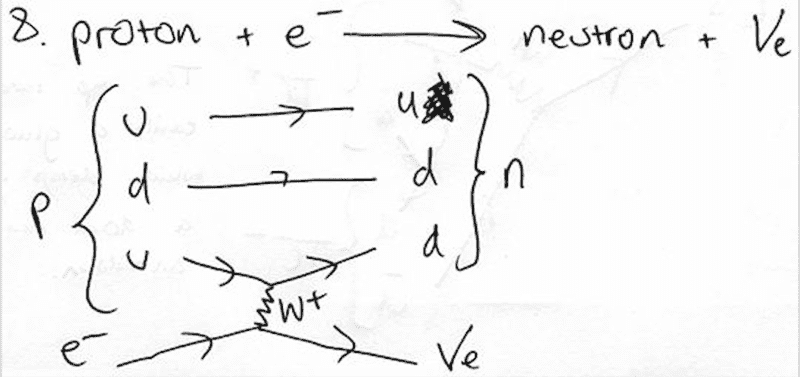
Screen Shot 2017-11-20 at 1.02.29 PM.png
 

Attachments

  • Screen Shot 2017-11-20 at 1.02.29 PM.png
    Screen Shot 2017-11-20 at 1.02.29 PM.png
    47.9 KB · Views: 839
Physics news on Phys.org
doggydan42 said:
would the electron or up quark emit the boson

Neither. The boson is exchanged between the electron/neutrino and the up quark/down quark, but neither one can be said to be the "emitter". You just have a Feynman diagram (at lowest order) with two interaction vertices.
 
PeterDonis said:
Neither. The boson is exchanged between the electron/neutrino and the up quark/down quark, but neither one can be said to be the "emitter". You just have a Feynman diagram (at lowest order) with two interaction vertices.

So to the diagram, it does not matter if the curve drawn for the W boson is further left at the vertex with the electron, being that time increases to the right?

Or to rephrase the question, does it matter which particle, up quark or electron, decays first?
 
doggydan42 said:
to the diagram, it does not matter if the curve drawn for the W boson is further left at the vertex with the electron, being that time increases to the right?

The diagram does not tell you where in spacetime the two vertexes are; the fact that it seems to when you draw it is misleading. In the actual math, this diagram corresponds to an infinite number of terms, one for each possible pair of spacetime locations for the vertexes.
 
PeterDonis said:
The diagram does not tell you where in spacetime the two vertexes are; the fact that it seems to when you draw it is misleading. In the actual math, this diagram corresponds to an infinite number of terms, one for each possible pair of spacetime locations for the vertexes.

Okay, thank you very much.
 

Similar threads

  • · Replies 2 ·
Replies
2
Views
2K
  • · Replies 15 ·
Replies
15
Views
2K
  • · Replies 3 ·
Replies
3
Views
3K
  • · Replies 4 ·
Replies
4
Views
2K
  • · Replies 3 ·
Replies
3
Views
6K
  • · Replies 6 ·
Replies
6
Views
3K
  • · Replies 10 ·
Replies
10
Views
4K
  • · Replies 1 ·
Replies
1
Views
2K
  • · Replies 3 ·
Replies
3
Views
2K
  • · Replies 5 ·
Replies
5
Views
5K