Feynman's Notes for The Feynman Lectures on Physics

Click For Summary

Discussion Overview

The discussion revolves around the posting of Richard Feynman's notes from his lectures at Caltech, specifically those related to The Feynman Lectures on Physics (FLP). Participants share their experiences with Feynman's teaching, the significance of the notes, and ongoing projects related to enhancing access to Feynman's work. The conversation includes technical aspects of web design and the challenges of self-studying physics.

Discussion Character

  • Exploratory
  • Technical explanation
  • Conceptual clarification
  • Debate/contested
  • Meta-discussion

Main Points Raised

  • Some participants express appreciation for the availability of Feynman's notes in a deep-zoomable format, highlighting the effort involved in making them accessible online.
  • One participant shares their personal experience of discovering Feynman's lectures in college and reflects on the challenges of understanding the material, suggesting that errata may contribute to the difficulty.
  • A participant discusses their work on improving the online edition of FLP, including technical enhancements to the website and plans for crowd-sourcing categorization and transcription of Feynman's handwritten notes.
  • There are inquiries about the possibility of providing downloadable PDF versions of the notes, with some participants speculating on legal constraints preventing this.
  • Another participant shares their own project of converting markdown files into readable PDF documents, drawing parallels to the challenges faced in studying physics and the need for effective tools.

Areas of Agreement / Disagreement

Participants generally agree on the value of Feynman's notes and the importance of making them accessible. However, there is no consensus on the feasibility of providing PDF downloads, and the discussion includes multiple perspectives on the challenges of understanding FLP and the technical aspects of related projects.

Contextual Notes

Some limitations are noted regarding the accessibility of Feynman's notes, including potential legal issues surrounding downloadable formats. Additionally, the discussion reflects varying levels of familiarity with Feynman's work and the technical challenges of self-study in physics.

Who May Find This Useful

Readers interested in Feynman's teaching methods, those studying physics, and individuals involved in web design or educational technology may find this discussion relevant.

codelieb
Messages
157
Reaction score
162
611 pages of notes Richard Feynman made in 1961-64 to plan and prepare lectures for Caltech's two-year introductory physics course, later known as The Feynman Lectures on Physics, have been posted in deep-zoomable format at The Feynman Lecture Website.

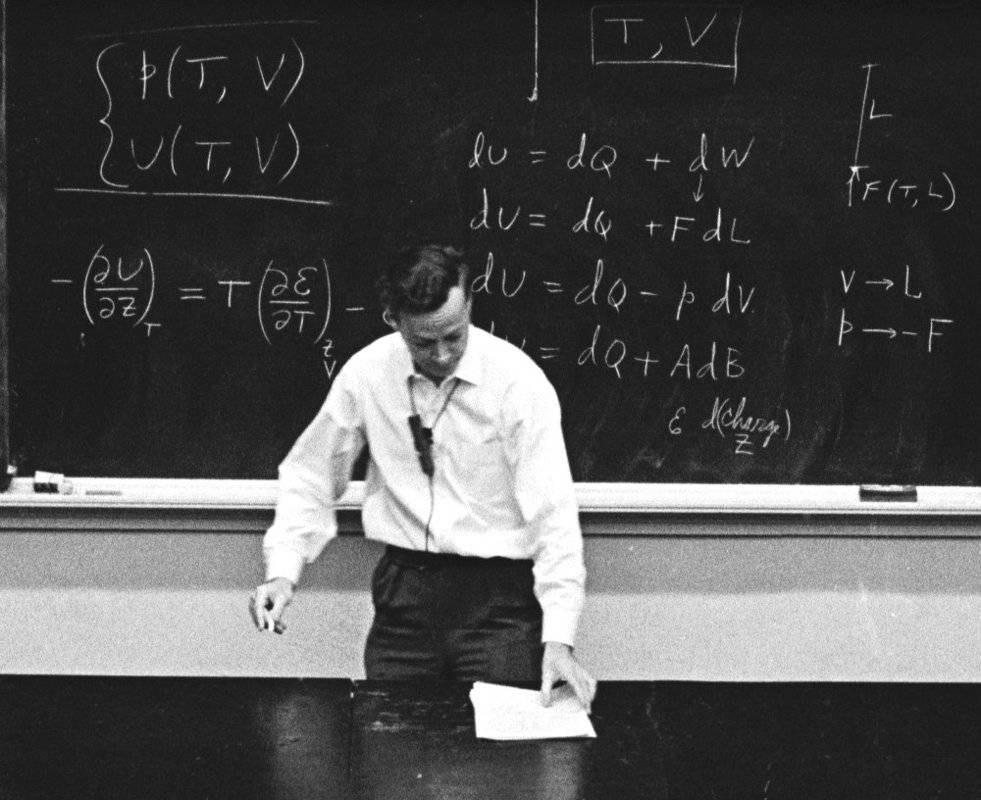
Photos of Feynman giving his undergraduate lectures (such as that below) show he almost always had a few pages of notes to which he referred occasionally. The pages that have been posted (at least most) were among the ones he used during his lectures.

Feynman's notes are provided for the enjoyment of the curious, and for scholars. A web-based "notes viewer" application is furthermore provided to aid in their organization and study.Mike Gottlieb
Editor, The Feynman Lectures on Physics New Millennium Edition
244291
 
  • Like
Likes   Reactions: bhobba, JD_PM, vela and 12 others
Physics news on Phys.org
Thanks for sharing this website on Feynman. He was a great and inspired teacher. I didn’t learn of his lectures until I got to college from fellow college students from NYC who studied them while in high school. Our school was quite primitive in that sense.

There are also some short interview clips and portions of the Cornell Messenger lectures available online on YouTube and a few years ago another PF member posted a collection of notes from Feynman seminars at Hughes.

http://www.thehugheslectures.info/the-lectures/
Can you tell us the latest status on your work on FLP, and on TIPS and anything else that helps us understand Feynman better? With Amazon links perhaps if relevant?
 
Hi. Perhaps it goes without saying that my latest work on FLP is publishing Feynman's FLP Notes. That project started in 2014, but I didn't work on it much until 2018. Shortly after I started on it my partner Rudi Pfeiffer complained that the text column in the online edition of FLP was too wide for him to read comfortably when the window was opened wide. Some other readers had made similar complaints over the years, so I decided to add a "limit text column width" feature. My first implementation performed poorly, and I discovered that was because the CSS for the online edition (that someone else wrote, not me) was very poorly coded - it was slowing everything down. So, I completely re-wrote the CSS of the online edition, reducing its bulk to 1/7th of what it had been, and making it much more efficient, not to mention easier to read and understand. While doing that I happened to notice that many of the tables in the online edition (written by the same person who wrote the bad CSS) were very poorly coded, so I re-wrote all the tables. While I was in the mood for making improvements I restructured the code, putting most of the javascript (which had been lexically included in the HTML files) into separate .js files, whose loading could be deferred. I also deferred the loading of image files in order to shorten the "time to first render" when loading the chapters of the online edition. I made various cosmetic changes along the way to the reference popups. After I was done with all that I went back to Feynman's FLP Notes. Posting them was quite a job. First all, the 611 pages of notes were very faded from age and barely readable. They needed to be 'enhanced' for readability, a big job that was done for me by a volunteer, Natalia Petrenko, a graphics artist in Belarus. Next I had to get a deep-zoom image server up and running (Caltech's DP dept. helped me with that), convert all the scans and enhanced scans to deep-zoomable format, get them up on the server, and test the server. The server didn't work at first! We had to upgrade it. Once it was working I set about writing the FLP Notes Viewer application, which is based on OpenSeadragon. That took a couple of months for me to write, and Natalia helped me again by making artwork for the UI. For my next project I am planning to develop a system for crowd-sourcing categorization and transcription of Feynman’s handwritten notes and his blackboards. I am working on that with Lars Næsheim, who made the ePub and Kindle editions of FLP and has also contributed to the online edition in various ways. I have no idea how long that will take. There are other things in the offing too, but they’re too speculative to mention in a public forum.
 
  • Like
Likes   Reactions: Spinnor and vanhees71
Great source! I guess, for legal reasons it's not possible to also provide downloads in pdf?
 
Your work is excellent and we all appreciate what you’ve done. Great web design is very hard to do unless you can find a model that seems to work well. You online work has also prompted me to go back and read Feynman again.

I remember the first time I read FLP in college I as so amazed but still couldn’t make the leaps needed to really understand the deeper meaning even after I had learned college physics. I felt so frustrated. Physics is really hard to self study since all physics textbooks never provide full solutions to problems so you can see how the master solved the problem.

I read the prefaces and began to see that perhaps the errata was what made reading FLP so difficult so I’ll try again. Is there an online forum to discuss FLP or perhaps @Greg Bernhardt could get something going here at PF, maybe even the crowdsourcing you wanted to do.

The crowdsourcing reminded me of the recent movie with Mel Gibson and Sean Penn about the creation of the Oxford English Dictionary where they used the first form of postal crowdsourcing invited the public to submit words and quotations of use to them for the dictionary development. The movie is based on a true story of Dr Miner, a former Civil War surgeon who murdered a poor English Workman believing he was out to kill him and Prof Murray editor of the OED who comes to appreciate the thoroughness of Dr Miners research. Maybe even a simple format for errata input like their word plus quotation could be used to make your work easier.

Please keep at it, you are definitely keeping the Feynman legacy alive and are inspiring our current and future generations to greater things.

On another front:

I’ve been struggling with something similar, trying to convert markdown files of my notes into readable pdf files complete with latex generated formulas, html links, images, colorized source code, drawings... and whatever else comes up when doing research.

My current approach has been to convert md to html and html to pdf. I embedded math Jax in the html for equation rendering, have developed a simple line by line program source code colorizer that works reasonably well across a dozen languages and am thinking about incorporating a drawing language I wrote years ago into the mix via SVG. The conversion program is written in python3.

Style wise, I’ve been trying to implement in HTML CSS, the Microsoft Word page format or something similar to what is seen in modern programming books. It’s been fun so far and I’m at the tweaking stage now to get it just right. The end result should handle math, physics, engineering and programming notes in one markdown styled document where you can easily paste in stuff from any source.

Next I might have to write an editor to go with it to have a wysiwyg view of things where drag and drop can be used to add to the md document.

This application is an alternative to using Jupyter notebooks as is popular in the numerical computing world today.
 
  • Like
Likes   Reactions: bhobba
vanhees71 said:
Great source! I guess, for legal reasons it's not possible to also provide downloads in pdf?

The purpose of posting Feynman's FLP notes in a deep zoomable format with a customized viewing application is to allow people online to examine them without the inconvenience of traveling to Caltech (in Pasadena, California) which has been the only way to do that until now. If you want copies, then you can apply to the Caltech Archives for them, just like I did.

These notes were not handed to me on a platter. I will tell you how I got my copies.

In 2007-8, while I was resident at Caltech, I specifically looked in the Caltech Archives for these notes. However, the Feynman Papers Collection was not so well-organized at that time, and I failed to find them. So, I thought they did not exist. Several years later Caltech's Archivist retired, and the new Archivist (Shelley Erwin) did a much better job of organizing the Feynman Papers collection. In 2013 Ralph Leighton went to the Archives looking for the original copy of a poem written by Feynman (The Universe in a Glass of Wine) that appears in FLP, and he found it among these notes that we are now publishing. Soon after, I heard through the grapevine of the existence of the notes. I got the idea of publishing them with the online edition of FLP before I ever saw them.

In 2014 I discussed this idea with Shelley Erwin, who granted me permission to do it, and the next time I visited Caltech I bought a paper copy of the notes, thinking I would organize them in paper before doing anything else. Well, that proved to be difficult, I soon got distracted with various other things... and to make a long story short, I dropped the ball.

Flash forward to May 2018, when I visited Caltech to join in the celebration of Feynman's 100th birthday. Shelley Erwin had just retired and Caltech had a brand new Archivist, Peter Collopy. Shelley had mentioned to Peter my plans to publish Feynman's notes online, and Peter, who is interested in publishing the entire Feynman Papers collection online, took the opportunity to introduce himself, and encouraged me to continue working on publishing Feynman's FLP notes. So, I decided to actually do it, at long last.

The first step was ordering an electronic copy of the 611 pages from the Caltech Archives (for which I had to pay. You can find the fee schedule here.) I ordered high-resolution color scans in TIFF format, and not PDFs, but that is a cheaper option. However, note: you will need a legitimate research reason and you will need to agree to limit the use of your copies in various ways. And, yes, to finally answer your question, this is for legal reasons.
 
Last edited:
  • Like
Likes   Reactions: dextercioby, Spinnor, vanhees71 and 2 others
So did you shell out over $6000 to get these copies? That’s some serious change. I hope they gave you a discount.
 
jedishrfu said:
Your work is excellent and we all appreciate what you’ve done. Great web design is very hard to do unless you can find a model that seems to work well. You online work has also prompted me to go back and read Feynman again.

Thanks for the kudos. I'm glad to hear that you're reading Feynman again.
 
  • Like
Likes   Reactions: jedishrfu
That's really great work! Thanks a lot again!
 
  • Like
Likes   Reactions: jedishrfu
  • #10
vanhees71 said:
That's really great work! Thanks a lot again!

You're welcome.
 
  • Like
Likes   Reactions: jedishrfu

Similar threads

  • · Replies 14 ·
Replies
14
Views
3K
  • · Replies 4 ·
Replies
4
Views
5K
  • · Replies 2 ·
Replies
2
Views
2K
  • · Replies 6 ·
Replies
6
Views
5K
  • · Replies 4 ·
Replies
4
Views
8K
  • Sticky
  • · Replies 33 ·
2
Replies
33
Views
12K
  • · Replies 28 ·
Replies
28
Views
4K
  • · Replies 4 ·
Replies
4
Views
3K
  • · Replies 3 ·
Replies
3
Views
5K
Replies
10
Views
7K