jonlg_uk
- 141
- 0
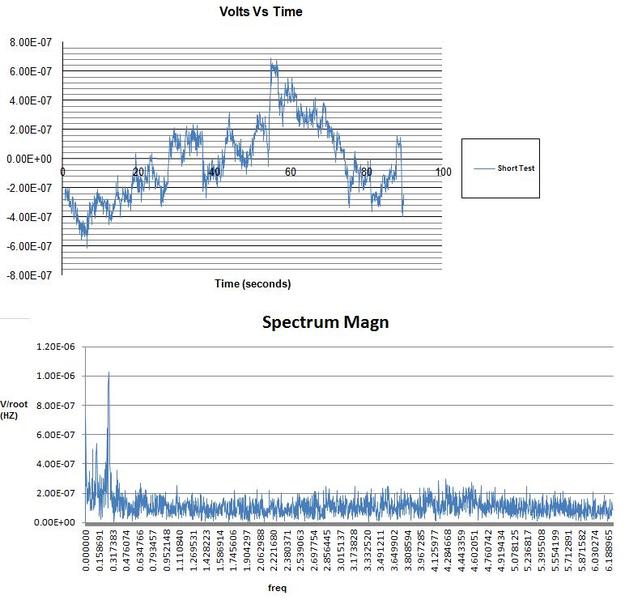
Hi all. I have been recording the thermal noise produced by a number of resistors. I have created a excel sheet that takes the readings from the 8 1/2 DVM and performs a FFT on them, in order to give me the frequency domain plot. However I am not 100% certain of what I am seeing because of my limited understanding on this topic.
Basically I am building a precision resistive divider that divides the high voltage produced by the power supply down to a measurable low voltage reading for the 8 1/2 DVM. My customer is requesting that the divider must perform suitably in order to allow the measurement of noise figures of less than 0.2ppm and drift of less than 1ppm/hour. THE "noise" I refer to is produced by the HV power supply. They basically want to measure the noise produced by this power supply.
Here is what I don't understand:
Say my high voltage power supply produced 10KV and my divider was had a ratio of 1:1000 then the output voltage of the divider would be 10V and 0.2ppm of 10V=2uV. So basically the divider needs to have a noise floor of less than 2uV. From the first plot the noise floor would correspond to the "thickness of the line" right? and the drift/hour would be the max-min of the voltage over a hour period, correct?
The other thing I don't understand is to do with the FFT plot. So the Y axis is measured in V/Root(Hz), say at 3Hz point on the FFT plot I see a noise value of ~0.2uV/Root Hz. Then does that mean that on the first plot (the time domain plot) if I was to zoom in of down to a resolution of BELOW 0.333seconds (1/3Hz) and measure all the points at say 6Hz (The Nyquist rate i.e. the minimum sampling rate required to avoid aliasing, equal to twice the highest frequency contained within the signal.) would I see average voltage amplitude of 0.2uV at 0.16666sec time intervals (1/6Hz) ? Would this mean that the divider is capable of being able to perform suitably in order to allow the measurement of noise figures of less than 0.2ppm, as the customer is asking for?
I basically want to know if the V/root(hz) seen on the frequency domain plot matches the raw voltage measurement seen on the time domain plot. What is the difference? and does the fact that I am reading ~0.2 uV/root(hz) on the frequency plot mean that the system is good for enabling noise measurement of less than 0.2ppm from the high voltage power supply?
I thank you all in advance
J
Basically I am building a precision resistive divider that divides the high voltage produced by the power supply down to a measurable low voltage reading for the 8 1/2 DVM. My customer is requesting that the divider must perform suitably in order to allow the measurement of noise figures of less than 0.2ppm and drift of less than 1ppm/hour. THE "noise" I refer to is produced by the HV power supply. They basically want to measure the noise produced by this power supply.
Here is what I don't understand:
Say my high voltage power supply produced 10KV and my divider was had a ratio of 1:1000 then the output voltage of the divider would be 10V and 0.2ppm of 10V=2uV. So basically the divider needs to have a noise floor of less than 2uV. From the first plot the noise floor would correspond to the "thickness of the line" right? and the drift/hour would be the max-min of the voltage over a hour period, correct?
The other thing I don't understand is to do with the FFT plot. So the Y axis is measured in V/Root(Hz), say at 3Hz point on the FFT plot I see a noise value of ~0.2uV/Root Hz. Then does that mean that on the first plot (the time domain plot) if I was to zoom in of down to a resolution of BELOW 0.333seconds (1/3Hz) and measure all the points at say 6Hz (The Nyquist rate i.e. the minimum sampling rate required to avoid aliasing, equal to twice the highest frequency contained within the signal.) would I see average voltage amplitude of 0.2uV at 0.16666sec time intervals (1/6Hz) ? Would this mean that the divider is capable of being able to perform suitably in order to allow the measurement of noise figures of less than 0.2ppm, as the customer is asking for?
I basically want to know if the V/root(hz) seen on the frequency domain plot matches the raw voltage measurement seen on the time domain plot. What is the difference? and does the fact that I am reading ~0.2 uV/root(hz) on the frequency plot mean that the system is good for enabling noise measurement of less than 0.2ppm from the high voltage power supply?
I thank you all in advance
J