Discussion Overview
The discussion revolves around finding a function $\displaystyle f(x)$ such that $\displaystyle \frac{1}{f(x)}$ is defined for all $\displaystyle x$, is bounded, and $\displaystyle f(x)$ is decreasing. The scope includes mathematical reasoning and exploration of function properties.
Discussion Character
- Exploratory, Mathematical reasoning, Debate/contested
Main Points Raised
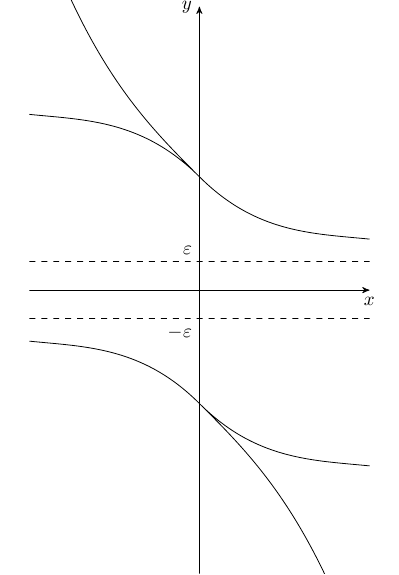
- Some participants propose that $\displaystyle f(x)$ must be non-zero and separated from zero, implying that there exists an $\displaystyle \varepsilon$ such that $\displaystyle |f(x)| > \varepsilon$ for all $\displaystyle x$.
- There is a question about the domain of the function, with participants confirming it is all real numbers.
- One participant expresses difficulty in finding such a function and asks for a description of how such a function behaves.
- Another participant notes that since $\displaystyle f(x)$ is decreasing, $\displaystyle \frac{1}{f(x)}$ is increasing and must approach a certain limit as $\displaystyle x \to \infty$.
- A suggestion is made for the function $\displaystyle f = 1 + e^{-x}$ as a potential candidate.
- There is a reiteration of the behavior of $\displaystyle f(x)$ and the implications of its decreasing nature on $\displaystyle \frac{1}{f(x)}$.
Areas of Agreement / Disagreement
Participants express differing levels of understanding and approaches to finding the function, with no consensus on a specific function or method to achieve the desired properties.
Contextual Notes
Participants discuss the need for $\displaystyle f(x)$ to remain outside a certain band defined by $\{(x,y):|y|\le\varepsilon\}$, but the implications of this condition remain unresolved.