Find Acceleration: Negative | Lines (a-e)

  • Thread starter Thread starter iac0b
  • Start date Start date
  • Tags Tags
    Acceleration
Click For Summary
SUMMARY

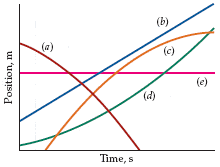
The discussion centers on identifying which position-versus-time curves represent negative acceleration, specifically focusing on lines (a), (b), (c), (d), or (e). Participants emphasize the importance of understanding the underlying concepts rather than simply providing answers. A key hint provided is to analyze the slope of the curve, as it directly indicates the object's acceleration. The conversation reinforces the educational principle of engaging with the problem-solving process to enhance comprehension.

PREREQUISITES
  • Understanding of position-versus-time graphs
  • Knowledge of acceleration and its relationship to slope
  • Familiarity with basic physics concepts
  • Ability to interpret graphical data
NEXT STEPS
  • Research the relationship between slope and acceleration in kinematics
  • Study different types of motion represented in position-versus-time graphs
  • Explore the concept of negative acceleration in physics
  • Learn about graphical analysis techniques for motion problems
USEFUL FOR

Students studying physics, educators teaching kinematics, and anyone interested in understanding motion analysis through graphical representations.
iac0b
Messages
5
Reaction score
0
Which of the position-versus-time curves in the figure below best shows the following. (Select all that apply.)

2-figure-28.gif


(d) The motion of an object with negative acceleration.
Lines (a), (b), (c), (d), or (e)
 
Last edited:
Physics news on Phys.org
What's your reasoning?
 
Well, I wish to know what the answer is and how to get it.
 
iac0b said:
Well, I wish to know what the answer is and how to get it.

I think he wants to know what exactly are you having a problem with in your question. Where exactly do you get stuck at? It wouldn't help you much if we just gave you the answer without making sure you understand HOW to get it. :smile:

Edit: PF rules don't let us just give people the answers to homework questions. Get as far as you can in the problem and then explain how you got there and what you don't understand if you can. Then we can help you!
 
iac0b said:
Well, I wish to know what the answer is and how to get it.
Here's a hint: What does the slope of the curve tell you?
 
The book claims the answer is that all the magnitudes are the same because "the gravitational force on the penguin is the same". I'm having trouble understanding this. I thought the buoyant force was equal to the weight of the fluid displaced. Weight depends on mass which depends on density. Therefore, due to the differing densities the buoyant force will be different in each case? Is this incorrect?

Similar threads

  • · Replies 6 ·
Replies
6
Views
1K
  • · Replies 5 ·
Replies
5
Views
3K
  • · Replies 16 ·
Replies
16
Views
1K
  • · Replies 9 ·
Replies
9
Views
485
  • · Replies 7 ·
Replies
7
Views
2K
  • · Replies 19 ·
Replies
19
Views
2K
  • · Replies 98 ·
4
Replies
98
Views
6K
Replies
1
Views
1K
Replies
1
Views
2K
  • · Replies 2 ·
Replies
2
Views
1K