Find Derivative - Get Guidance Here

  • Thread starter Thread starter npellegrino
  • Start date Start date
  • Tags Tags
    Derivative
Click For Summary
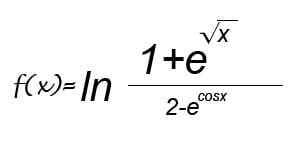
The discussion centers on finding the derivative of a complex function involving logarithmic and exponential components. The user expresses confusion about applying the derivative rules correctly, particularly regarding the function u = (1+e^sqrtX)/(2-e^cosx). Participants clarify that the derivative of e^sqrtX requires the chain rule, confirming that the correct derivative is e^sqrtX * (1/(2sqrtX)). Additionally, there is criticism of the user's initial application of the logarithmic differentiation rule, emphasizing the need for proper understanding of derivative concepts. Overall, the conversation highlights the importance of correctly applying differentiation rules and the chain rule in calculus.
npellegrino
Messages
17
Reaction score
0
I am having difficulty figuring this one, any guidance will be appreciated.

24mz1bb.jpg
 
Physics news on Phys.org
We cannot guide you until you show us where you get stuck. What kind of methods have you tried to use so far?
 
This is what I have so far.

I believe i use this rule d/dx log a ^ u = 1/(lna)u

so ln = 1
a = ln
u = (1+e^sqrtX)/(2-e^cosx)

now i need to take the derivative of u, does e^sqrtX = e^sqrtX or is it e^sqrtX * derivative of sqrtX making it e^sqrtX * 1/2sqrtX

d/dx u =
 
I believe i use this rule d/dx log a ^ u = 1/(lna)u

This 'rule' makes no sense whatsoever.

now i need to take the derivative of u, does e^sqrtX = e^sqrtX or is it e^sqrtX * derivative of sqrtX making it e^sqrtX * 1/2sqrtX

This is also pretty hard to read. Yes \exp(\sqrt{x})=\exp(\sqrt{x}). This is no surprise since everything equals itself. What you probably mean is \frac{d}{dx}\exp(\sqrt{x})=\exp(\sqrt{x}). That is wrong since you have to use the chain rule therefore your second guess,\frac{d}{dx}\exp(\sqrt{x})=\exp(\sqrt{x}) \frac{1}{2 \sqrt{x}}, is correct.
 
Question: A clock's minute hand has length 4 and its hour hand has length 3. What is the distance between the tips at the moment when it is increasing most rapidly?(Putnam Exam Question) Answer: Making assumption that both the hands moves at constant angular velocities, the answer is ## \sqrt{7} .## But don't you think this assumption is somewhat doubtful and wrong?

Similar threads

  • · Replies 7 ·
Replies
7
Views
2K
  • · Replies 7 ·
Replies
7
Views
2K
  • · Replies 1 ·
Replies
1
Views
1K
  • · Replies 18 ·
Replies
18
Views
3K
  • · Replies 5 ·
Replies
5
Views
2K
Replies
3
Views
1K
  • · Replies 7 ·
Replies
7
Views
2K
Replies
8
Views
2K
  • · Replies 4 ·
Replies
4
Views
1K
  • · Replies 2 ·
Replies
2
Views
2K