Find Det (C) knowing Det(A) and Det(B)

  • Thread starter Thread starter mmmboh
  • Start date Start date
Click For Summary
SUMMARY

The discussion centers on the properties of determinants, specifically how to find the determinant of matrix C given the determinants of matrices A and B. The key takeaway is that the determinant is a multilinear function of its rows, allowing for the expression of det(A, B+D, C) as det(A, B, C) + det(A, D, C). This property clarifies that while determinants do not simply add when matrices are summed, they can be manipulated through linear combinations of their rows. Understanding this fundamental property is crucial for accurately calculating determinants in linear algebra.

PREREQUISITES
  • Understanding of 3x3 matrices and their determinants
  • Familiarity with linear combinations of vectors
  • Knowledge of multilinear functions in linear algebra
  • Basic concepts of matrix operations and properties
NEXT STEPS
  • Study the properties of determinants, focusing on multilinearity
  • Explore linear combinations of vectors in the context of matrix operations
  • Learn about the implications of the determinant in transformations and linear mappings
  • Review examples of determinant calculations involving multiple matrices
USEFUL FOR

Students and professionals in mathematics, particularly those studying linear algebra, as well as anyone involved in computational mathematics or engineering requiring determinant calculations.
mmmboh
Messages
401
Reaction score
0
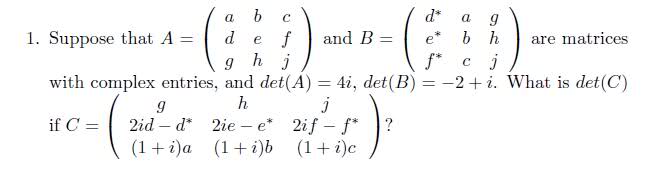
Hi, right now I have two 3x3 matrices with letter entries, I know the determinant of A and the determinant of B, and I am given a matrix C for which I have to find the determinant for. Right now I am expressing matrix C as a combination of A and B, but what happens to the determinant when I add matrices A and B together?

azgej6.jpg
 
Physics news on Phys.org
One of the rows of C is a linear combination of two vectors. det is linear in the row entries, right?
 
Well all the rows in C are a linear combination of vectors in A and B.
 
mmmboh said:
Well all the rows in C are a linear combination of vectors in A and B.

I'm referring to the second row being a sum of two vectors.
 
Ok, that's true, but how does that help me in finding the new determinant? I still have to know what happens when I add the matrices together, unless you mean something else?
 
I mean that if the letters A, B, C, and D are row vectors then det(A,B+D,C)=det(A,B,C)+det(A,D,C). det is linear in the row vectors.
 
Ah I didn't know you can do that :S...thanks!
 
But wait I don't understand how that works...why do the B and D add but nothing else...isn't this sort of like saying det(A+B)=det(A)+det(B) which isn't true?
 
mmmboh said:
But wait I don't understand how that works...why do the B and D add but nothing else...isn't this sort of like saying det(A+B)=det(A)+det(B) which isn't true?

No, it's not the same thing. I'm using that det is a multilinear function of it's rows (or columns). It's a fundamental property of the determinant. Try and find it in your book. It's important.
 

Similar threads

  • · Replies 11 ·
Replies
11
Views
2K
  • · Replies 2 ·
Replies
2
Views
7K
  • · Replies 5 ·
Replies
5
Views
5K
  • · Replies 25 ·
Replies
25
Views
4K
  • · Replies 5 ·
Replies
5
Views
2K
  • · Replies 17 ·
Replies
17
Views
2K
  • · Replies 9 ·
Replies
9
Views
2K
  • · Replies 6 ·
Replies
6
Views
2K
  • · Replies 2 ·
Replies
2
Views
5K
  • · Replies 1 ·
Replies
1
Views
2K