Find magnitude of two velocities, with one at an angle?

Click For Summary
SUMMARY

The discussion focuses on calculating the magnitude of two velocities, specifically a glider's velocity and wind velocity, using vector components and the Pythagorean theorem. Participants emphasize breaking down the wind into its x and y components and finding the corresponding components for the glider. The correct magnitude was determined to be 68.67 after addressing calculation errors, particularly with negative values. Additionally, the importance of accurately sketching vectors to visualize the resultant direction is highlighted.

PREREQUISITES
  • Understanding of vector components in physics
  • Proficiency in trigonometry, particularly sine and cosine functions
  • Familiarity with the Pythagorean theorem
  • Basic skills in sketching vector diagrams
NEXT STEPS
  • Learn how to resolve vectors into components using trigonometric functions
  • Study the application of the Pythagorean theorem in vector addition
  • Explore vector diagram techniques for visualizing resultant vectors
  • Practice problems involving multiple vectors in two-dimensional motion
USEFUL FOR

Students studying physics, particularly those learning about vector addition and motion, as well as educators looking for practical examples to illustrate these concepts.

Brianna I
Messages
8
Reaction score
1
Member advised to use the homework template for posts in the homework sections of PF.
Here is the problem:
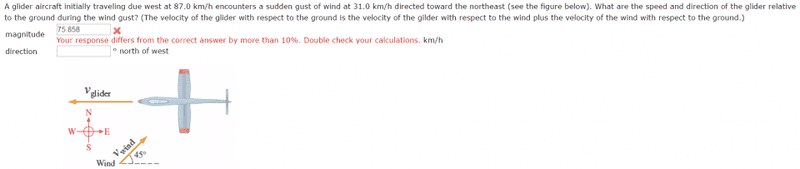
upload_2016-9-17_16-13-35.png


I am sure I can use pythagorean theorem of quadratic equation to solve but to be honest I'm blanking ridiculously.
I have tried setting it on a coordinate grid and finding the resultant, but I have had no luck! I know I've done this problem before in high school but I'm blanking and have spent a few hours now contemplating this.
Thank you!
 
Physics news on Phys.org
You could start by breaking up the wind into its x and y components. Remember your trig.
 
Kpgabriel said:
You could start by breaking up the wind into its x and y components. Remember your trig.
Hi! I have tried what you said but still do not have the right answer. Here is my work:
upload_2016-9-17_16-54-27.png


Excuse the writing, I'm in a car haha!
 
Brianna I said:
Hi! I have tried what you said but still do not have the right answer. Here is my work:
View attachment 106148

Excuse the writing, I'm in a car haha!
Ok, so you found your components for the wind. Now find the components for the glider. look on your graph what angle is the glider traveling?
 
Kpgabriel said:
Ok, so you found your components for the wind. Now find the components for the glider. look on your graph what angle is the glider traveling?
Sorry, it looks like you already have the components for the resultant vector. So you should have no problem finding the magnitude by using Pythagorean theorem.
 
Kpgabriel said:
Sorry, it looks like you already have the components for the resultant vector. So you should have no problem finding the magnitude by using Pythagorean theorem.
Hi, as you can see I tried that. It did not work :( Do I sum both the x-coordinates? I had 31cos45 - 87 since they are on opposite sides of the coordinate grid.
 
Kpgabriel said:
Ok, so you found your components for the wind. Now find the components for the glider. look on your graph what angle is the glider traveling?
Ah, would it be at 180o?
 
  • Like
Likes   Reactions: Kpgabriel
Brianna I said:
Hi, as you can see I tried that. It did not work :( Do I sum both the x-coordinates? I had 31cos45 - 87 since they are on opposite sides of the coordinate grid.
Right, what did that give you?
 
Brianna I said:
Ah, would it be at 180o?
Yes it would.
 
  • #10
Kpgabriel said:
Right, what did that give you?
92.037. I checked, not the right answer (for part a)
 
  • #11
Brianna I said:
92.037. I checked, not the right answer (for part a)
I am getting a different answer. You have r^2 = (-65.08)^2 + (21.92)^2 ?
 
  • #12
Kpgabriel said:
I am getting a different answer. You have r^2 = (-65.08)^2 + (21.92)^2 ?
Ah, my mistake. I redid it and got 68.67. I just checked and it is correct! Thank you! I will be able to solve for the angle :)
I must have been too sloppy with the numbers, I realized my calculator was still keeping the negative number even while being squared, messing everything up.
Thanks again!
 
  • #13
Brianna I said:
Ah, my mistake. I redid it and got 68.67. I just checked and it is correct! Thank you! I will be able to solve for the angle :)
I must have been too sloppy with the numbers, I realized my calculator was still keeping the negative number even while being squared, messing everything up.
Thanks again!
You're welcome!
 
  • #14
The problem also asks for the direction of the glider's ground track. (In your sketch, the directional sense of vector R is wrong.) It may help to draw the vectors to scale and connect them head to tail to get a preliminary ballpark resultant.
 

Similar threads

Replies
25
Views
2K
  • · Replies 5 ·
Replies
5
Views
2K
Replies
14
Views
958
Replies
4
Views
2K
  • · Replies 21 ·
Replies
21
Views
1K
  • · Replies 3 ·
Replies
3
Views
3K
  • · Replies 15 ·
Replies
15
Views
1K
  • · Replies 6 ·
Replies
6
Views
2K
  • · Replies 6 ·
Replies
6
Views
2K
  • · Replies 5 ·
Replies
5
Views
3K