Find Ratio of d/b for Minimum Stress in Beams & Bending

  • Thread starter Thread starter Dell
  • Start date Start date
  • Tags Tags
    Beams Bending
Click For Summary
SUMMARY

The discussion focuses on determining the optimal ratio of diameter (d) to width (b) of a beam to minimize maximum stress (σmax). The maximum stress is defined by the equation σmax=Ymax(M/I), where I is the moment of inertia for a rectangle, calculated as I=bh³/12. Participants explore the relationship between d and b, concluding that the ratio d/b approaches √2 for minimal stress conditions. The conversation emphasizes the importance of understanding geometric constraints and differentiation in solving the problem.

PREREQUISITES
  • Understanding of beam stress and bending theory
  • Familiarity with moment of inertia calculations for rectangular sections
  • Knowledge of differentiation and optimization techniques
  • Basic geometry involving circles and rectangles
NEXT STEPS
  • Study beam bending theory and stress analysis in structural engineering
  • Learn about moment of inertia for various shapes, including circles and rectangles
  • Explore optimization techniques in calculus, particularly for constrained problems
  • Investigate the implications of geometric constraints in structural design
USEFUL FOR

Structural engineers, mechanical engineers, and students studying mechanics of materials who are interested in optimizing beam design for minimal stress conditions.

Dell
Messages
555
Reaction score
0
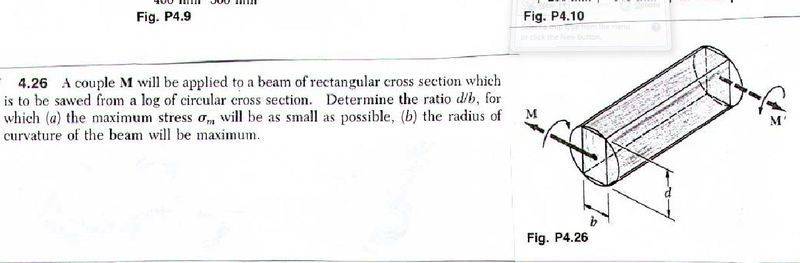
find the ratio of d/b such that the largest stress in the beam will be minimum
Capture.JPG


i know that the maximum stress is

σmax=Ymax\frac{M}{I}

and i know that for a rectangle I=bh3/12

now in the question i am asked to find the ration of the (diameter of the log)/(the width of the rectangle) such that σmax is minimal

since the rectangle is contained in the circle

d2=b2+h2
where h is the height of the rectangle

σmax=Ymax\frac{M}{I}

σmax=(h/2)*(12M/(bh2)
σmax=6M/(b*h2)
σmax=6M/(b*(d2-b2)

basically from here i need to find the ratio d/b so that (b*(d2-b2) is maximum,

but how can i do this??

d/b=K

(b*(d2-b2)
=(bd2-b3)

=d/b*(d*b2-b4/d)

but i can't get to the ratio, i feel i am so close but just not getting it
 
Last edited:
Physics news on Phys.org
That is not shear stress. Your comment does not make sense. [EDIT: OK, you edited your post in response to my comment, without letting anyone know, thereby making my above comment appear as nonsense.]

You seem to not understand what d is, as if you have not looked at the diagram.
 
Last edited:
at first i thought that d was the height of the rectangle, but thatdidnt make sense to me, if that is so what is the circular log given for?? it is not 100% clear to me in the diagram what they mean by d.

as far as i know that is the equation for stress,

how would you have gone about solving it??
 
Use a straightedge to see what d is.
 
so you say that d is the height of the beam, if so why do they need to tell me that the beam is taken from a log,

if i take the height as d

I=bd3/12

σmax=(h/2)*(12M/(bd3)
σmax=6M/(b*d2)

now i need b*d2 to be maximum

but i still can't get to the ratio??

i supose that b*d2 will be maximum when d/b-->infinity
but that doesn't seem right at all
 
never mind, i think i got it

b2+d2=D2

i differentiate the stress equation adn compare to 0 and i get sqrt(2)
 
They don't tell you the size of the log, but the ratio r= d/b is constrained by the circular boundary. In my experience, if a problem says to find a ratio, then the first line should be: Let r be the ratio. Then work everything towards equations in r.
 
thanks but i got it already sqrt(2)
 

Similar threads

  • · Replies 2 ·
Replies
2
Views
3K
  • · Replies 5 ·
Replies
5
Views
4K
  • · Replies 11 ·
Replies
11
Views
4K
  • · Replies 16 ·
Replies
16
Views
17K
Replies
6
Views
2K
Replies
6
Views
5K
  • · Replies 1 ·
Replies
1
Views
2K
  • · Replies 3 ·
Replies
3
Views
5K
  • · Replies 2 ·
Replies
2
Views
7K
  • · Replies 3 ·
Replies
3
Views
3K