Find Side AB: Calculate Using m & n Ratios

  • Thread starter Thread starter quee
  • Start date Start date
quee
Messages
7
Reaction score
2
Hello.
There is a problem:
"Through D on a side AB of the triangle ABC drawn a line parallel to AC intersecting BC in E. D is such that CD:DB = m:n. Find DE:AC"
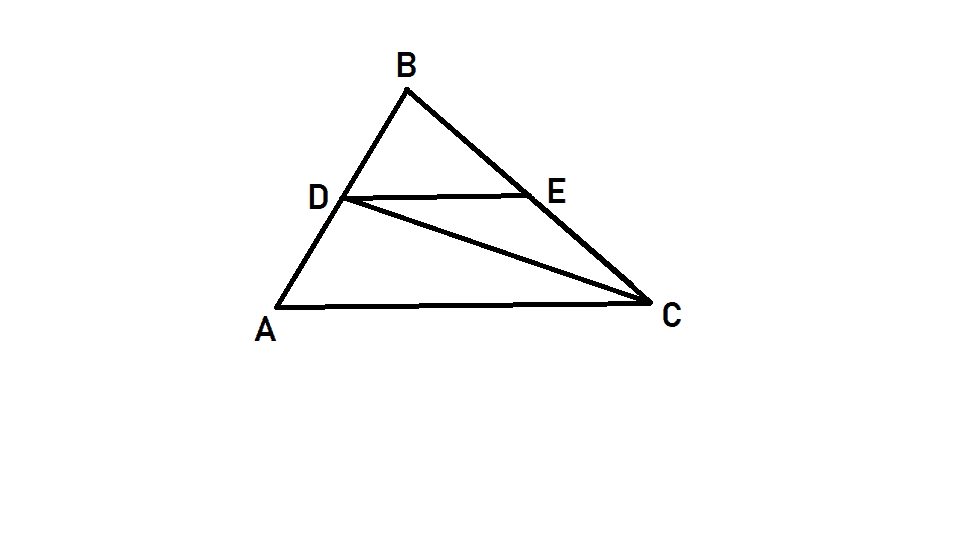
1.png


So it is easy to find out that DB:AB equals to DE:AC as DE and AC are parallel. Since DB = n, there is only one need to express AB in terms of n and m. But how to do it? I tried using similar triangles, but I can't get AB through it. The trapezoid ADEC also gives no results as the second diagonal is unknown.
 
Physics news on Phys.org
I think you need also ##AE## and the intersection of both diagonals ##AE## and ##CD## in, say ##F##. This will make things more complicated as there will be more lengths involved, but I don't see another way to get hold on ##CD##. Then use the intercept theorem.
 
  • Like
Likes quee
fresh_42 said:
I think you need also ##AE## and the intersection of both diagonals ##AE## and ##CD## in, say ##F##.
Thank you. Actually, I considered that there may be not enough information in the problem. Now I am convinced.
 
quee said:
Thank you. Actually, I considered that there may be not enough information in the problem. Now I am convinced.
I am not sure. It depends on how the result has to look like. E.g. I got for the quotient
$$\dfrac{DE}{AC} =\dfrac{n}{m} \cdot \dfrac{CD}{AD+DB}$$
but it's not clear whether this will do or not. I don't see a second equation for ##CD##.
 
  • Like
Likes quee
Since ##DE## is parallel to ##AC##, you can use the similarity of triangles ##ABC## and ##ADE##. You have from the proportion that is given:
$$AD:DB = m:n \Rightarrow nAD = mDB$$
This means that ##AB = AD + DB = \left(\frac{m}{n} + 1\right) DB##. So now you have the proportion between ##AB## and ##DB## and from similarity you get the proportion between ##DE## and ##AC##.
 
  • Like
Likes Delta2
Antarres said:
Since ##DE## is parallel to ##AC##, you can use the similarity of triangles ##ABC## and ##ADE##. You have from the proportion that is given:
$$AD:DB = m:n \Rightarrow nAD = mDB$$
This means that ##AB = AD + DB = \left(\frac{m}{n} + 1\right) DB##. So now you have the proportion between ##AB## and ##DB## and from similarity you get the proportion between ##DE## and ##AC##.
Did you misread the given information?

Statement says: ##CD:DB = m:n##, not ##AD:DB ##.
quee said:
D is such that CD:DB = m:n. Find DE:AC"
 
@SammyS Indeed, I completely misread it. Apologies to the OP. In that case the exercise seems more complicated.
Might be that the method fresh gave would work, I so far don't see a clear way to get the proportion.
 
Antarres said:
Indeed, I completely misread it. Apologies to the OP.

It is okay. Thank you for your reply.
If only $$AD:DB= m:n,$$ it would be completely obvious that $$\frac{DE}{AC} = \frac{n}{n+m}$$
But this is, unfortunately, a much harder problem. Or it may be an actual lack of some information in the problem.
 
  • Like
Likes SammyS

Similar threads

  • · Replies 5 ·
Replies
5
Views
2K
  • · Replies 4 ·
Replies
4
Views
4K
Replies
2
Views
2K
  • · Replies 1 ·
Replies
1
Views
2K
  • · Replies 1 ·
Replies
1
Views
3K
  • · Replies 2 ·
Replies
2
Views
2K
  • · Replies 6 ·
Replies
6
Views
3K
  • · Replies 1 ·
Replies
1
Views
1K
Replies
14
Views
10K
  • · Replies 1 ·
Replies
1
Views
1K