Discussion Overview
The discussion revolves around finding the angles in a cyclic quadrilateral given certain angle measures and the center of the circle. Participants explore the implications of the inscribed angle theorem and the conditions under which the angles can be determined.
Discussion Character
- Exploratory
- Mathematical reasoning
- Debate/contested
Main Points Raised
- One participant states that $\angle ACD=50$ based on the inscribed angle theorem and seeks help to find $\angle ACB$.
- Several participants question whether the lines $\overline{AC}$ and $\overline{BD}$ intersect at the center $O$ of the circle, noting that the problem does not specify this intersection.
- Another participant expresses doubt about the sufficiency of the information provided, suggesting that if the lines do intersect at $O$, then $\angle ACB$ could be $40^\circ$.
- One participant corrects themselves, indicating that if $\overline{AC}$ intersects $\overline{BD}$ at $O$, then $\angle ACB$ would indeed be $40^\circ$, but emphasizes that without this intersection, there is insufficient information.
- Another participant mentions Thales' theorem, suggesting that if $O$ is on $BD$, it could lead to the conclusion that the required angle is $40^\circ$.
- Concerns are raised that without the intersection, the angle at $A$ does not have to be $90^\circ$, which could lead to various possible values for the required angle.
Areas of Agreement / Disagreement
Participants express differing views on whether the intersection of the lines is necessary to determine the angles. There is no consensus on the sufficiency of the information provided in the problem.
Contextual Notes
The discussion highlights limitations regarding the assumptions about the intersection of lines and the implications for angle measures. The lack of explicit information about the intersection leads to uncertainty in determining the angles.

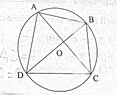
 - if $\overline{AC}$ intersects $\overline{BD}$ at $O$, then $\angle{ACB}=40^\circ$, so I'd assume that is the case - without that I don't think there's enough information.