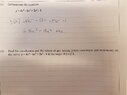
Find the coordinates and the nature of any turning points (maximum and minimum)

Click For Summary

Discussion Overview

The discussion revolves around finding the coordinates and nature of turning points (maximum and minimum) for a given function, specifically focusing on the critical points derived from the first derivative. Participants are engaged in a mathematical reasoning process to solve the problem presented in a homework context.

Discussion Character

  • Homework-related
  • Mathematical reasoning

Main Points Raised

  • One participant expresses difficulty in understanding how to find turning points and seeks assistance.
  • Another participant confirms the first derivative of the function as \(y' = 16x^3 - 18x^2 + 4x\) and suggests solving \(y' = 0\) to find critical values.
  • A subsequent reply agrees with the factorization of the derivative and identifies critical values, including \(x = 0\) and the roots from the quadratic factor.
  • Participants discuss the need to determine the nature of the turning points using derivative tests, but do not specify which method to use.

Areas of Agreement / Disagreement

Participants generally agree on the factorization of the derivative and the identification of critical values. However, the discussion does not reach a consensus on the methods for determining the nature of the turning points.

Contextual Notes

There are unresolved steps in the mathematical reasoning, particularly regarding the application of derivative tests to classify the turning points.
b4rn5ey
Messages
3
Reaction score
0
So I've been trying to wrap my head around this one for several hours now and it just has me stumped. I'm begging, someone, anyone, walk me through it before I swear off numbers for life hahah (Part b)

Imgur: The most awesome images on the Internet

View attachment 6600

Thanks in advance for any help anyone can provide :)
 

Attachments

  • loWsY3G.jpg
    loWsY3G.jpg
    55.3 KB · Views: 118
Last edited by a moderator:
Physics news on Phys.org
Hello, and welcome to MHB, b4rn5ey! (Wave)

In part (a) of the problem, you correctly found:

$$y'=16x^3-18x^2+4x$$

To find the turning points, and we observe that $y'=0$ at such points, we need to find the roots of $y'$ (our critical values)...that is, we need to solve:

$$16x^3-18x^2+4x=0$$

I would suggest factoring to get a linear factor and a quadratic factor...what do you get?
 
MarkFL said:
Hello, and welcome to MHB, b4rn5ey! (Wave)

In part (a) of the problem, you correctly found:

$$y'=16x^3-18x^2+4x$$

To find the turning points, and we observe that $y'=0$ at such points, we need to find the roots of $y'$ (our critical values)...that is, we need to solve:

$$16x^3-18x^2+4x=0$$

I would suggest factoring to get a linear factor and a quadratic factor...what do you get?
Thanks for the reply..

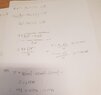
So I've tried to find the first turning point using your advice..

This seem right? Or am i walking off track>

Imgur: The most awesome images on the Internet

View attachment 6601
 

Attachments

  • Y0lLcpP.jpg
    Y0lLcpP.jpg
    21.4 KB · Views: 117
I agree with your factorization:

$$y'=2x\left(8x^2-9x+2\right)=0$$

I also agree with the critical values you obtained from the quadratic factor:

$$x=\frac{9\pm\sqrt{17}}{16}$$

However, there is another factor involving $x$ that must be equated to zero, which is simply:

$$x=0$$

So, this gives us 3 critical values, and 3 possible turning points:

$$y(0)=-1$$

$$y\left(\frac{9-\sqrt{17}}{16}\right)=\frac{51\sqrt{17}-2155}{2048}$$

$$y\left(\frac{9+\sqrt{17}}{16}\right)=-\frac{51\sqrt{17}+2155}{2048}$$

Now, you need to determine the nature of these points, using either the first or second derivative tests. :D

If you are going to upload images of your work rather than typeset it for easier reading, please attach the images inline rather than hot-linking to the image...this way I won't have to follow the link, download the image, resize and crop the image, and edit your post to attach it inline so it can be read in the post.
 

Similar threads

  • · Replies 3 ·
Replies
3
Views
2K
  • · Replies 2 ·
Replies
2
Views
2K
  • · Replies 7 ·
Replies
7
Views
2K
  • · Replies 10 ·
Replies
10
Views
3K
  • · Replies 20 ·
Replies
20
Views
4K
  • · Replies 2 ·
Replies
2
Views
2K
  • · Replies 3 ·
Replies
3
Views
1K
  • · Replies 2 ·
Replies
2
Views
2K
Replies
5
Views
3K
  • · Replies 4 ·
Replies
4
Views
7K