Find the cubic equation that has -1 and 2i as roots

  • Topic:
  • Thread starter Thread starter pan90
  • Start date Start date
  • Tags Tags
    Cubic Roots
Join the discussion
Registration is free. Start your own thread to ask a follow-up.
3 replies · 3K views
pan90
Messages
4
Reaction score
0
Answer is given, but no explanation or logic for it.

View attachment 9220

From HiSet free practice test
 
Attachments
  • cubic equation problem.jpg
    cubic equation problem.jpg
    7.3 KB · Views: 223
Mathematics news on Phys.org
pan90 said:
Answer is given, but no explanation or logic for it.
From HiSet free practice test
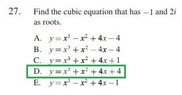
You need to show what you have tried, even if it is wrong. That will enable us to help you better.

Note that, for a polynomial with real coefficients, if we have a complex root then we also have the complex conjugate as a root as well. So your cubic polynomial is [math]f(x) = a( x - (-1))(x - (2i))(x - (-2i))[/math].

(The "a" is there because the polynomial will have the same roots no matter what constant is multiplying the whole thing. Your answer key is setting a = 1.)

-Dan

Edit: The method worked to give the right answer, but the signs were wrong. The terms for the given roots are of the form x - r, not x + r as I had originally written.
 
Substitute $x=-1$ and $x=2i$ in each of the given expressions. Do you get $0$? If the same expression gives $0$ for both these two values of $x$, then the equation is the one you’re looking for; otherwise, it isn’t.

Right, let’s do it one at a time. Start with $x=-1$. Substitute this in each of the five expressions A–E. You’ll find that B and D give you $0$ whereas A, C and E don’t. Therefore the correct answer is either B or D (you have eliminated A, C and E).

Now substitute $x=2i$ in B and in D. One will give you $0$ while the other won’t. The one that gives you $0$ is the one you’re looking for.
 
First, there exist an infinite number of different cubic equations that have "-1" and "2i" as roots, Notice that all of the proposed solutions have real coefficients. A polynomial equation with real coefficients but a non-real root must also have the complex conjugate of that non-real root as a root. The complex conjugate of "2i" is "-2i" so the polynomial must be [tex](x+ 1)(x- 2i)(x+ 2i)= (x- 1)(x^2+ 4)= x^3- x^2+ 4x- 4[/tex].