MHB Find the derivative using implicit differentiation (with inverse trig functions)

Click For Summary
The discussion focuses on using implicit differentiation to find the derivative dy/dx involving inverse trigonometric functions. A participant shared their progress but struggled with the complexity of the math. Another user provided a detailed breakdown of the equation, clarifying the components involved in solving for y'. They emphasized the transformation of the equation into a linear form and derived the final expression for y'. The explanation was well-received, highlighting the effectiveness of clear communication in solving mathematical problems.
Umar
Messages
36
Reaction score
0
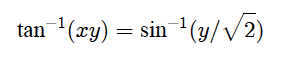
Here is the question:

View attachment 6100

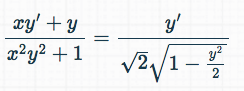
This is the step I came to after taking the derivatives and doing some simplification:

View attachment 6101

^ I did the work myself on paper, I just couldn't type out the whole thing clearly so that anyone else can see what I'm referring too... so I used some online tool to show that step.

Now, my main concern here is solving for y', or essentially, dy/dx. I have tried numerous ways, but the math gets too ugly.
If anyone could please give this a try as soon as possible, that would be extremely appreciated!
 

Attachments

  • Screen Shot 2016-10-17 at 9.29.54 PM.png
    Screen Shot 2016-10-17 at 9.29.54 PM.png
    1.6 KB · Views: 98
  • Screen Shot 2016-10-17 at 9.35.04 PM.png
    Screen Shot 2016-10-17 at 9.35.04 PM.png
    4.3 KB · Views: 107
Physics news on Phys.org
Hi Umar,

The denominator of the right hand side of your equation is $\sqrt{2-y^2}$ by the rule $\sqrt{a}\sqrt{b} = \sqrt{ab}$. The left hand side can be written

$$\frac{y}{x^2y^2 + 1} + \left(\frac{x}{x^2y^2 + 1}\right)y'$$

So you have a linear equation in the form $A + By' = Cy'$ where

$$A = \frac{y}{x^2y^2 + 1},\quad B = \frac{x}{x^2y^2 + 1},\quad \text{and}\quad C = \frac{1}{\sqrt{2-y^2}}$$

We have $A = Cy' - By'$, or $A = (C - B)y'$. Show that $$C - B = \frac{x^2y^2 + 1 - x\sqrt{2-y^2}}{(x^2y^2 + 1)\sqrt{2-y^2}}$$ and complete the steps to obtain

$$y' = \frac{y\sqrt{2-y^2}}{x^2y^2 + 1 - x\sqrt{2-y^2}}$$
 
Euge said:
Hi Umar,

The denominator of the right hand side of your equation is $\sqrt{2-y^2}$ by the rule $\sqrt{a}\sqrt{b} = \sqrt{ab}$. The left hand side can be written

$$\frac{y}{x^2y^2 + 1} + \left(\frac{x}{x^2y^2 + 1}\right)y'$$

So you have a linear equation in the form $A + By' = Cy'$ where

$$A = \frac{y}{x^2y^2 + 1},\quad B = \frac{x}{x^2y^2 + 1},\quad \text{and}\quad C = \frac{1}{\sqrt{2-y^2}}$$

We have $A = Cy' - By'$, or $A = (C - B)y'$. Show that $$C - B = \frac{x^2y^2 + 1 - x\sqrt{2-y^2}}{(x^2y^2 + 1)\sqrt{2-y^2}}$$ and complete the steps to obtain

$$y' = \frac{y\sqrt{2-y^2}}{x^2y^2 + 1 - x\sqrt{2-y^2}}$$

Wow! Thank you so much. You explained it with so much simplicity that it never really looked hard at all. Thank you!
 
There are probably loads of proofs of this online, but I do not want to cheat. Here is my attempt: Convexity says that $$f(\lambda a + (1-\lambda)b) \leq \lambda f(a) + (1-\lambda) f(b)$$ $$f(b + \lambda(a-b)) \leq f(b) + \lambda (f(a) - f(b))$$ We know from the intermediate value theorem that there exists a ##c \in (b,a)## such that $$\frac{f(a) - f(b)}{a-b} = f'(c).$$ Hence $$f(b + \lambda(a-b)) \leq f(b) + \lambda (a - b) f'(c))$$ $$\frac{f(b + \lambda(a-b)) - f(b)}{\lambda(a-b)}...

Similar threads

Replies
9
Views
2K
  • · Replies 7 ·
Replies
7
Views
2K
  • · Replies 2 ·
Replies
2
Views
3K
  • · Replies 4 ·
Replies
4
Views
2K
  • · Replies 3 ·
Replies
3
Views
2K
  • · Replies 8 ·
Replies
8
Views
2K
  • · Replies 1 ·
Replies
1
Views
2K
  • · Replies 5 ·
Replies
5
Views
3K
  • · Replies 2 ·
Replies
2
Views
2K
Replies
9
Views
2K