Find the differential equation

Click For Summary
SUMMARY

The discussion centers on deriving the differential equation for a family of straight lines tangent to a circle, represented by the equation y=(-m/n)x+(m^2/n)+n, where (m,n) are points of intersection. Participants emphasize the importance of using polar coordinates to simplify the problem, suggesting that the angle on the circle serves as the primary parameter. The differential equation for the tangent lines is established as dy/dx=c, where c is an arbitrary constant, and can be expressed in terms of the coordinates of the circle. The conversation highlights the need for implicit differentiation and the conversion between polar and Cartesian coordinates.

PREREQUISITES
  • Understanding of differential equations, specifically dy/dx notation.
  • Familiarity with polar coordinates and their relationship to Cartesian coordinates.
  • Knowledge of implicit differentiation techniques.
  • Basic concepts of geometry related to circles and tangents.
NEXT STEPS
  • Study the derivation of the differential equation for tangent lines in polar coordinates.
  • Learn about implicit differentiation and its application in finding derivatives of functions defined implicitly.
  • Research the geometric properties of circles and their tangents to enhance understanding of the topic.
  • Explore the conversion methods between polar and Cartesian coordinates for better application in problems.
USEFUL FOR

Mathematicians, physics students, and anyone interested in differential equations and geometric interpretations of curves and tangents.

MatinSAR
Messages
673
Reaction score
204
Homework Statement
Find the differential equation of a family of straight lines that are tangent to the circle x^2+y^2=c^2?
Relevant Equations
Circle equation , mm'=-1,y-y1=m(x-x1)
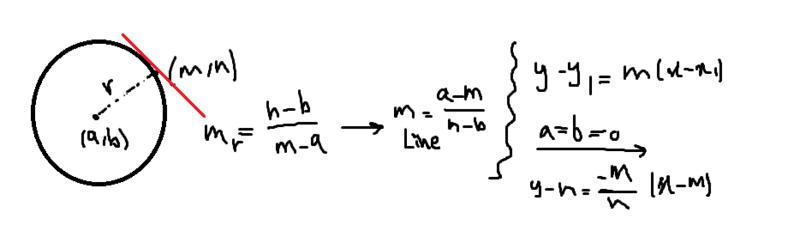
Hi ... I have written the equation of family of straight lines which are tangent to the circle as :
y=(-m/n)x+(m^2/n)+n
line intersects circle at : (m,n)
1652785565041.png


But I can't understand how to find differential equation of this ...

I will be appreciated if anyone has extra time to give me a little guidance on this question.
 
Physics news on Phys.org
I think the generic goal here is to rewrite the equation as lhs is a function of the coordinates, and rhs is a function of only the parameter that you pick to set which curve you have, and then you differentiate. Then integrating both sides gives you lhs = arbitrary number, and the choice of number sets your parameter (by inverting the function on the rhs)

You have two parameters (m and n) so you're in trouble to start. Your real parameter that picks your curve is the angle on the circle.

Does your differential equation have to be in Cartesian coordinates? I think it's a lot more natural in polar coordinates since you're trying to isolate an angle.

Step one is to write down the equation of a line in polar coordinates
Remember the tangent line to the circle is the set of points which in vector form are radius vector + something perpendicular to the radius vector. This means it's the set of points which, when you take the dot product with the radius vector of your set angle, gives you ##c^2##.

This actually gives you a really nice and simple representation of an arbitrary line perpendicular to the circle at angle ##\alpha## (remember the dot product can be computed using the lengths of the vectors and the angle between them!) I'll stop here and give you a chance to figure out the equation and solve the problem from here, let me know
 
  • Like
Likes MatinSAR
I am not sure what the problem is asking for, the differential equation of any family of straight lines is $$\frac{dy}{dx}=c$$ where c an arbitrary constant. Unless the problems wants to identify c in terms of the coordinates x and y of a point of circle. Yes it is $$c=-\frac{x}{y}$$ where (x,y) a point on the circle (or ##-\frac{m}{n}## since you used (m,n) for the point on circle.
 
Last edited:
  • Like
Likes MatinSAR
BTW, what you did to find the general equation of tangent line is not wrong, but you could do it another way: Find the derivative ##\frac{dy}{dx}## of the equation of the circle (by implicit differentiation of the equation of the circle), then the equation of the tangent line that passes at point (x,y) of the circle is $$Y-y=\frac{dy}{dx}(X-x)$$.

I used capital X and Y for a point of the tangent line and small x and y for a point of the circle.
 
  • Like
Likes MatinSAR
Office_Shredder said:
Step one is to write down the equation of a line in polar coordinates
Thank you ... But can you share a link which describes how to write the equation of a line in polar coordinates?
Delta2 said:
I used capital X and Y for a point of the tangent line and small x and y for a point of the circle.
Thank you.
 
  • Like
Likes Delta2
@Office_Shredder the differential equation you proposing, will have differentiation with respect to which variable? If I understand well you mean differentiation with respect to some angle but what angle i didnt quite understand.
 
  • Like
Likes MatinSAR
Delta2 said:
@Office_Shredder the differential equation you proposing, will have differentiation with respect to which variable? If I understand well you mean differentiation with respect to some angle but what angle i didnt quite understand.

You should be able to describe an arbitrary line at ##f(r,\theta)= C## for some constant ##C## that only depends on your initial parameter (th angle that your point on the circle was at ). Then you can use implicit differentiation, just take the derivative with respect to either r or ##\theta## to be honest (though I think ##\theta## is more natural).

If you really need this to be in x and y terms you can turn ##r## and ##\theta## back into ##x## and ##y## and then differentiate with respect to ##x##.
 
  • Like
Likes MatinSAR
MatinSAR said:
Thank you ... But can you share a link which describes how to write the equation of a line in polar coordinates?

Thank you.
Do you know what I mean when I say 'the set of points on the tangent line are the set of points for which the dot product with ##(m,n)## is ##c^2##?

If so I can hit you with a linear algebra derivation, if not I'll have to think about the right way to present it.

Edit: an elementary construction. Suppose in polar coordinates the point on the circle is at ##(c,\alpha)## - ##c## is the distance from the origin and ##\alpha## is the angle from the x axis. Now pick a random angle ##\theta## and consider the choice of ##r## such that ##(r,\theta)## is on the line. You now have a right triangle - the radius line segment between the origin and ##(c,\alpha)##, the line segment between the origin and ##(r,\theta)## and the line segment on the tangent line between ##(c,\alpha)## and ##(r,\theta)##. Write down a trigonometric equation that this triangle satisfies. (What is the angle at the origin?)
 
Last edited:
  • Like
Likes MatinSAR

Similar threads

  • · Replies 7 ·
Replies
7
Views
2K
  • · Replies 4 ·
Replies
4
Views
2K
Replies
3
Views
2K
  • · Replies 1 ·
Replies
1
Views
2K
  • · Replies 3 ·
Replies
3
Views
923
Replies
10
Views
2K
  • · Replies 27 ·
Replies
27
Views
2K
  • · Replies 8 ·
Replies
8
Views
2K
Replies
9
Views
2K
  • · Replies 10 ·
Replies
10
Views
2K