Find the displacement from equilibrium after some time

Click For Summary
SUMMARY

The discussion centers on calculating the displacement from equilibrium of a 50 lb weight attached to a spring, initially stretched 6 inches, after π/8 seconds. The correct displacement is confirmed to be 0.2 ft, while one participant mistakenly calculated it as 0.11 ft. Key equations used include (d²/dt²) + (k/m)x = 0 and the mass calculation m = w/g, where g = 32 ft/s². The importance of maintaining symbolic representations until the final calculation is emphasized to avoid errors.

PREREQUISITES
  • Understanding of differential equations, specifically second-order linear equations.
  • Knowledge of spring mechanics, including Hooke's Law (F = ks).
  • Familiarity with mass calculations in physics (m = w/g).
  • Basic principles of oscillatory motion and equilibrium in mechanical systems.
NEXT STEPS
  • Study the derivation and application of the differential equation (d²/dt²) + (k/m)x = 0.
  • Learn about the calculation of spring constants and their significance in oscillatory systems.
  • Explore the concept of damping in oscillatory motion and its effects on displacement.
  • Review numerical methods for solving differential equations in mechanical contexts.
USEFUL FOR

Students in physics or engineering courses, particularly those focusing on mechanics and oscillatory systems, as well as educators seeking to clarify concepts related to spring dynamics and displacement calculations.

Mason Smith
Messages
21
Reaction score
2

Homework Statement


A 50 lb weight is attached to the end of a spring. The spring is stretched 6 inches. Find the displacement from equilibrium of the weight after (π/8) seconds, if the weight is released from a point 2 inches above the equilibrium position. Round to the nearest length of a foot.

Homework Equations


(d2/dt2) + (k/m)x =0
mass m = w/g, where g = 32 ft/s2
F=ks, where k is the spring constant and s is how much the spring is stretched​

The Attempt at a Solution


My professor says that the answer is 0.2 ft. However, I am getting 0.11 ft.
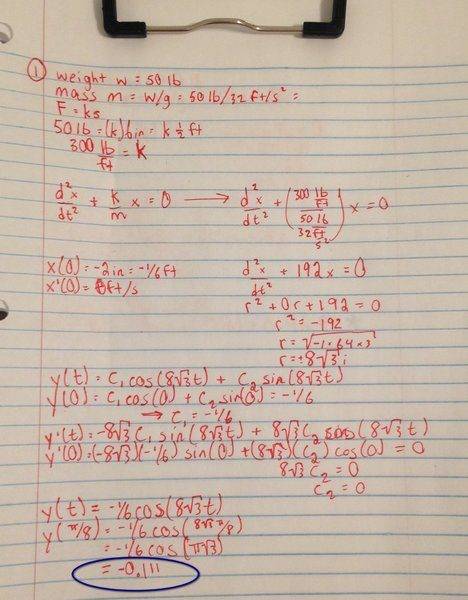
attempt.jpg


Attachments

  • attempt.jpg
    attempt.jpg
    44.5 KB · Views: 531
Physics news on Phys.org
In the future, please type out your attempt instead of just attaching an image of your work. (See the homework guidelines, item 5.)

What happened here?
upload_2018-7-11_7-56-24.png


In general, you should try not to insert numbers in the beginning of your solution - it makes it easy for errors to propagate without any easy means of checking your computations other than checking every single step. Give names to your knowns and unknowns and keep them until you have an expression for your sought quantity in terms of known quantities. Then, and only then, should you start inserting numerical values.
 

Attachments

  • upload_2018-7-11_7-56-24.png
    upload_2018-7-11_7-56-24.png
    14.2 KB · Views: 410
Isn't something wrong in your calculation of the spring cpnstant?
 

Similar threads

  • · Replies 5 ·
Replies
5
Views
3K
  • · Replies 5 ·
Replies
5
Views
2K
  • · Replies 6 ·
Replies
6
Views
2K
  • · Replies 5 ·
Replies
5
Views
2K
Replies
14
Views
2K
Replies
6
Views
3K
Replies
26
Views
3K
Replies
9
Views
2K
  • · Replies 2 ·
Replies
2
Views
4K
  • · Replies 6 ·
Replies
6
Views
3K