Find the escape velocity from 2 point charges

Click For Summary
SUMMARY

The discussion focuses on calculating the escape velocity from two point charges using the equation V(esc) = sqrt(4kQq / mr). The user initially struggles with the concepts of potential energy (PE) and kinetic energy (KE), particularly in defining initial and final configurations. Key insights include the importance of conservation of energy, where the total energy remains constant (E_i = E_f), and the necessity to correctly identify the values for r in the potential energy equations. The user ultimately realizes the need to clarify the initial potential energy for the proton in relation to the charges.

PREREQUISITES
  • Understanding of potential energy (PE) and kinetic energy (KE) in physics
  • Familiarity with the conservation of energy principle
  • Knowledge of point charge interactions and electric fields
  • Basic algebra for manipulating equations involving square roots and constants
NEXT STEPS
  • Review the concept of electric potential energy in the context of point charges
  • Study the conservation of energy in mechanical systems
  • Learn about the mathematical derivation of escape velocity in electrostatic systems
  • Explore the implications of charge configurations on potential energy calculations
USEFUL FOR

Students studying physics, particularly those focusing on electrostatics and energy conservation, as well as educators seeking to clarify concepts related to point charges and escape velocity calculations.

r-swald
Messages
13
Reaction score
3
Homework Statement
2 charges of -6nC are placed on the y-axis, on .005m above, and one .005m below the origin. A proton is launched from origin to the right along the x-axis. What is the escape velocity (m/s)?
Relevant Equations
PE = kQq / r
KE = mv^2 / 2
Below is the work I've attempted. I used 2 PE b'c there were 2 point charges, and only one KE b'c only the proton is moving. The final equation in case it's hard to see is V(esc) = sqrt (4kQq / mr).

I'm not sure if I did it right. Did I set up this equation right? and I am also not sure what to plug in for "r".
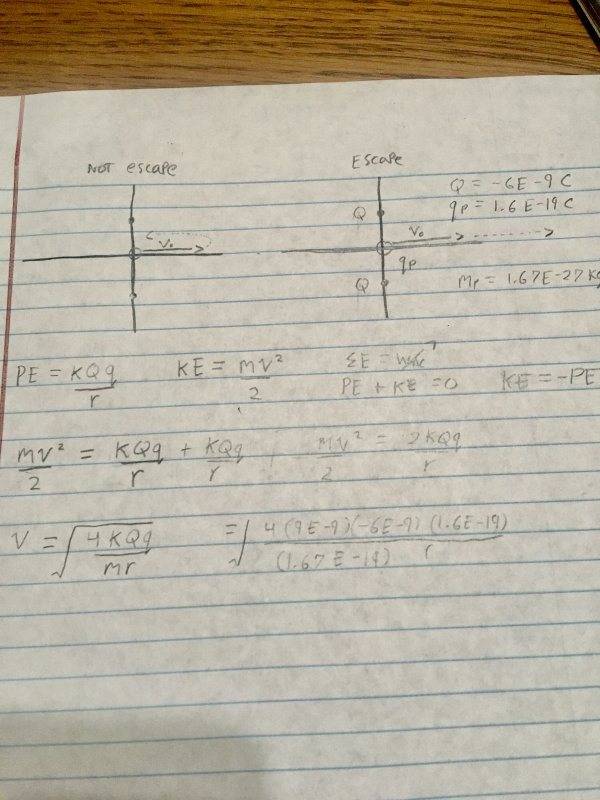
IMG_1250.jpeg
 
Physics news on Phys.org
r-swald said:
I'm not sure if I did it right. Did I set up this equation right? and I am also not sure what to plug in for "r".

You wrote that ##\sum E = W_{\rm nc}##. But, this is not quite right.

##W_{\rm nc}## is the work done by nonconservative forces as the system changes from some initial configuration to some final configuration. ##W_{\rm nc}## equals the change in total energy ##E## of the system as the system goes from the initial to final configuration.

That is, ##\Delta E = W_{\rm nc}## ##\,\,\,\,\,## (The ##\Delta## symbol is essential here.)

You know that ##W_{\rm nc} = 0## for this problem. Thus, ##\Delta E =0##.

This means that ##E_i = E_f## ##\,\,\,## or ##\,\,\,## ##KE_i+PE_i = KE_f + PE_f## ##\,\,\,\,##(conservation of energy)

You are given information about the initial configuration. You will need to decide what to take for the final configuration. Then consider what to write for ##KE_i##, ##PE_i ##, ##KE_f##, and ##PE_f##.

If you are clear on the initial and final configurations, then you should be able to see what to use for ##r## in ##PE_i## and ##PE_f##.
 
  • Informative
  • Like
Likes berkeman and r-swald
TSny said:
You are given information about the initial configuration. You will need to decide what to take for the final configuration. Then consider what to write for ##KE_i##, ##PE_i ##, ##KE_f##, and ##PE_f##.

If you are clear on the initial and final configurations, then you should be able to see what to use for ##r## in ##PE_i## and ##PE_f##.

Ah, okay I mixed up change in and sum of.
I tried this again and I must be thinking screwy b'c the final KE I figured to be 0 since V final would be approaching 0, and the final PE I figured to be 0 since r final would approach infinity.
I also ended up with 0 initial PE b'c the top and bottom charges would cancel out.
I don't know what I'm doing.
 
r-swald said:
Ah, okay I mixed up change in and sum of.
I tried this again and I must be thinking screwy b'c the final KE I figured to be 0 since V final would be approaching 0, and the final PE I figured to be 0 since r final would approach infinity.
That all sounds good.
I also ended up with 0 initial PE b'c the top and bottom charges would cancel out.
Think about this some more. What's the initial PE for the proton and the charge Q at y = .005 m? What 's the initial PE for the proton and the charge Q at y = -.005 m?
 
  • Like
Likes r-swald
TSny said:
That all sounds good.
Think about this some more. What's the initial PE for the proton and the charge Q at y = .005 m? What 's the initial PE for the proton and the charge Q at y = -.005 m?

Right, negative distance isn't possible, they'd only cancel if the charges were opposite. Thank you!
 
  • Like
Likes TSny

Similar threads

  • · Replies 7 ·
Replies
7
Views
2K
  • · Replies 5 ·
Replies
5
Views
2K
  • · Replies 5 ·
Replies
5
Views
2K
Replies
2
Views
2K
  • · Replies 7 ·
Replies
7
Views
1K
  • · Replies 6 ·
Replies
6
Views
981
Replies
14
Views
3K
  • · Replies 5 ·
Replies
5
Views
2K
  • · Replies 7 ·
Replies
7
Views
2K
  • · Replies 13 ·
Replies
13
Views
2K