Find the escape velocity from 2 point charges

Click For Summary

Homework Help Overview

The discussion revolves around finding the escape velocity from a system of two point charges, focusing on the conservation of energy principles and the potential energy involved in the setup. Participants are examining the correct application of energy equations in this context.

Discussion Character

  • Exploratory, Conceptual clarification, Mathematical reasoning, Assumption checking

Approaches and Questions Raised

  • Participants discuss the setup of the energy equations, questioning the definitions of initial and final configurations, and the appropriate values for potential energy and kinetic energy. There is uncertainty about the correct interpretation of variables and the implications of conservation of energy.

Discussion Status

The discussion is active, with participants providing insights and prompting each other to clarify their understanding of the initial and final states of the system. Some guidance has been offered regarding the interpretation of potential energy and the conditions under which it is calculated.

Contextual Notes

There is a noted confusion regarding the initial and final potential energy values, particularly in relation to the positions of the charges and the implications of their signs. Participants are also grappling with the implications of distance approaching infinity in their calculations.

r-swald
Messages
13
Reaction score
3
Homework Statement
2 charges of -6nC are placed on the y-axis, on .005m above, and one .005m below the origin. A proton is launched from origin to the right along the x-axis. What is the escape velocity (m/s)?
Relevant Equations
PE = kQq / r
KE = mv^2 / 2
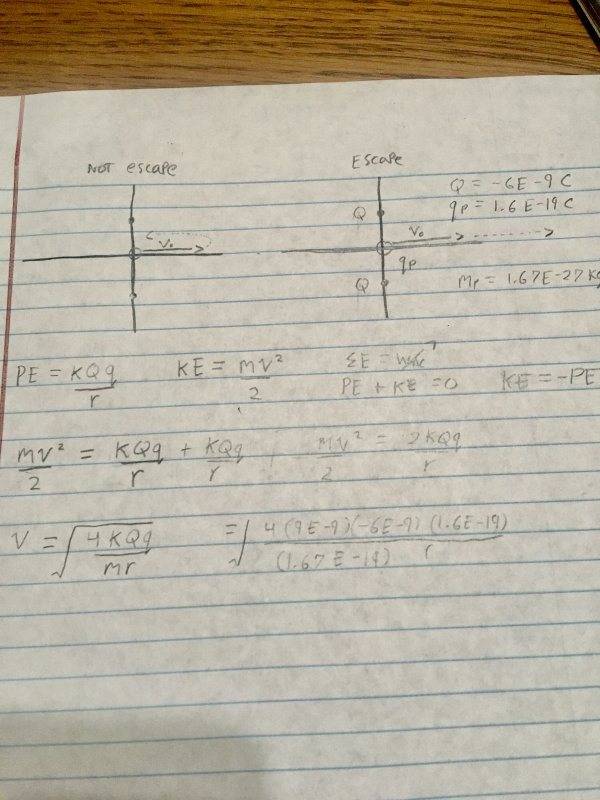
Below is the work I've attempted. I used 2 PE b'c there were 2 point charges, and only one KE b'c only the proton is moving. The final equation in case it's hard to see is V(esc) = sqrt (4kQq / mr).

I'm not sure if I did it right. Did I set up this equation right? and I am also not sure what to plug in for "r".
IMG_1250.jpeg
 
Physics news on Phys.org
r-swald said:
I'm not sure if I did it right. Did I set up this equation right? and I am also not sure what to plug in for "r".

You wrote that ##\sum E = W_{\rm nc}##. But, this is not quite right.

##W_{\rm nc}## is the work done by nonconservative forces as the system changes from some initial configuration to some final configuration. ##W_{\rm nc}## equals the change in total energy ##E## of the system as the system goes from the initial to final configuration.

That is, ##\Delta E = W_{\rm nc}## ##\,\,\,\,\,## (The ##\Delta## symbol is essential here.)

You know that ##W_{\rm nc} = 0## for this problem. Thus, ##\Delta E =0##.

This means that ##E_i = E_f## ##\,\,\,## or ##\,\,\,## ##KE_i+PE_i = KE_f + PE_f## ##\,\,\,\,##(conservation of energy)

You are given information about the initial configuration. You will need to decide what to take for the final configuration. Then consider what to write for ##KE_i##, ##PE_i ##, ##KE_f##, and ##PE_f##.

If you are clear on the initial and final configurations, then you should be able to see what to use for ##r## in ##PE_i## and ##PE_f##.
 
  • Informative
  • Like
Likes   Reactions: berkeman and r-swald
TSny said:
You are given information about the initial configuration. You will need to decide what to take for the final configuration. Then consider what to write for ##KE_i##, ##PE_i ##, ##KE_f##, and ##PE_f##.

If you are clear on the initial and final configurations, then you should be able to see what to use for ##r## in ##PE_i## and ##PE_f##.

Ah, okay I mixed up change in and sum of.
I tried this again and I must be thinking screwy b'c the final KE I figured to be 0 since V final would be approaching 0, and the final PE I figured to be 0 since r final would approach infinity.
I also ended up with 0 initial PE b'c the top and bottom charges would cancel out.
I don't know what I'm doing.
 
r-swald said:
Ah, okay I mixed up change in and sum of.
I tried this again and I must be thinking screwy b'c the final KE I figured to be 0 since V final would be approaching 0, and the final PE I figured to be 0 since r final would approach infinity.
That all sounds good.
I also ended up with 0 initial PE b'c the top and bottom charges would cancel out.
Think about this some more. What's the initial PE for the proton and the charge Q at y = .005 m? What 's the initial PE for the proton and the charge Q at y = -.005 m?
 
  • Like
Likes   Reactions: r-swald
TSny said:
That all sounds good.
Think about this some more. What's the initial PE for the proton and the charge Q at y = .005 m? What 's the initial PE for the proton and the charge Q at y = -.005 m?

Right, negative distance isn't possible, they'd only cancel if the charges were opposite. Thank you!
 
  • Like
Likes   Reactions: TSny

Similar threads

  • · Replies 7 ·
Replies
7
Views
2K
  • · Replies 5 ·
Replies
5
Views
3K
  • · Replies 5 ·
Replies
5
Views
2K
Replies
2
Views
2K
  • · Replies 7 ·
Replies
7
Views
1K
  • · Replies 6 ·
Replies
6
Views
1K
Replies
14
Views
3K
  • · Replies 5 ·
Replies
5
Views
2K
  • · Replies 7 ·
Replies
7
Views
2K
  • · Replies 13 ·
Replies
13
Views
3K