gnits
- 137
- 46
- Homework Statement
- To find the height to which a mass rises
- Relevant Equations
- PE=mgh
Hi,
Could I please ask for help regarding the following question.
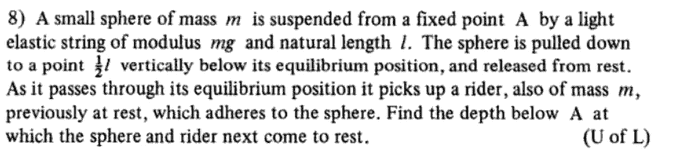
The book answer H = ( 3 - 3 sqrt(2)/4 ) L
(natural length of string is L)
Here is my diagram:
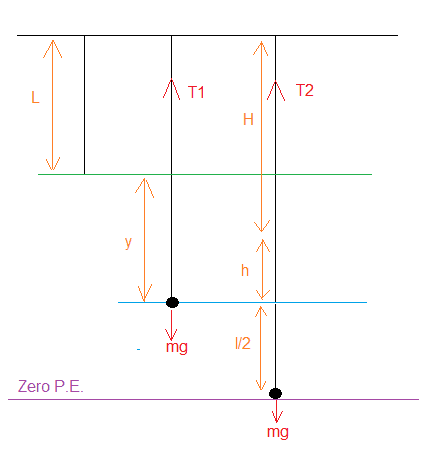
The green level represents the unstretched string.
The blue level is the string and mass in equilibrium.
The purple level is the mass at its lowest level.
When the mass reaches the blue level it will pick up the rider.
Here's my method:
Equating forces in the equilibrium positions gives: (using tension in elastic string = Yx/L where Y = elastic modulus, x = extension and L = natural length.)
mgy/L = mg
and so we find that y = L. This is the equilibrium position of the sphere.
I am solving the problem by considering energy. Energy in elastic string = Yx^2/ 2L
Let h be the maximum height above the equilibrium position which the combined masses reach.
So, equating energy at lowest point (all elastic energy) to energy at highest point to which sphere and rider rise (remaining elastic energy plus potential energy of the mass of the sphere and rider) gives:
( mg(L + L/2)^2 ) / ( 2L ) = ( mg(L - h)^2) / ( 2L ) + ( 2mg( (L/2) + h ) )
This doesn't lead me to the books answer.
Is this a valid way to attack the problem? If so, what silly mistake have I made?
Thanks for any help,
Mitch.
Could I please ask for help regarding the following question.
The book answer H = ( 3 - 3 sqrt(2)/4 ) L
(natural length of string is L)
Here is my diagram:
The green level represents the unstretched string.
The blue level is the string and mass in equilibrium.
The purple level is the mass at its lowest level.
When the mass reaches the blue level it will pick up the rider.
Here's my method:
Equating forces in the equilibrium positions gives: (using tension in elastic string = Yx/L where Y = elastic modulus, x = extension and L = natural length.)
mgy/L = mg
and so we find that y = L. This is the equilibrium position of the sphere.
I am solving the problem by considering energy. Energy in elastic string = Yx^2/ 2L
Let h be the maximum height above the equilibrium position which the combined masses reach.
So, equating energy at lowest point (all elastic energy) to energy at highest point to which sphere and rider rise (remaining elastic energy plus potential energy of the mass of the sphere and rider) gives:
( mg(L + L/2)^2 ) / ( 2L ) = ( mg(L - h)^2) / ( 2L ) + ( 2mg( (L/2) + h ) )
This doesn't lead me to the books answer.
Is this a valid way to attack the problem? If so, what silly mistake have I made?
Thanks for any help,
Mitch.