Find the ratio of lines in a circle

  • Topic:
  • Thread starter Thread starter mitaka90
  • Start date Start date
  • Tags Tags
    Circle Lines Ratio
Join the discussion
Registration is free. Start your own thread to ask a follow-up.
3 replies · 3K views
mitaka90
Messages
9
Reaction score
0
I have no idea how to solve this problem.
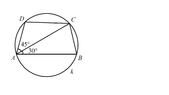
ABCD is just an irregular Quadrilateral so nothing too special with that figure.
We are looking for the ratio BC:CD and we only have that two angles. I know that the answer is 1:√2, but I have no idea how to find it.
 
Attachments
  • mathproblem.png
    mathproblem.png
    14.1 KB · Views: 150
Mathematics news on Phys.org
mitaka90 said:
I have no idea how to solve this problem.
ABCD is just an irregular Quadrilateral so nothing too special with that figure.
We are looking for the ratio BC:CD and we only have that two angles. I know that the answer is 1:√2, but I have no idea how to find it.

Hi mitaka90! Welcome to MHB! ;)

We are looking at an inscribed or chordic quadrilateral.
Its associated proposition states that its opposite angles sum up to $180^\circ$.
So we have:
$$\angle B + \angle D = 180^\circ \quad \Rightarrow \quad \angle D = 180^\circ - \angle B \tag 1$$

Furthermore, according to the Law of Sines, we have:
$$\frac{BC}{\sin 30^\circ} = \frac{AC}{\sin \angle B} \tag 2$$
respectively:
$$\frac{CD}{\sin 45^\circ} = \frac{AC}{\sin \angle D} \tag 3$$

Combining (1) and (3) gives:
$$\frac{CD}{\sin 45^\circ} = \frac{AC}{\sin(180^\circ - \angle B)} = \frac{AC}{\sin \angle B} \tag 4$$

See what comes next?
 
Yep, pretty straight forward from here. I can't believe how I couldn't work out that there would be some trigonometric functions stuff going on, specifically law of sines, because of the square root in the answer and the angles in the actual problem, lol. Thanks a lot! :) Btw, feel free to delete my first post if you can. I don't know why I've posted two times.
 
By the inscribed angle theorem, $\angle{CDB}=30^\circ$ and $\angle{CBD}=45^\circ$.

Construct the altitude of $\triangle{BCD}$ from $C$ to $\overline{BD}$ and, without a loss of generality, assign it a length of $1$ unit. Now it's easy to determine the (resulting) lengths of $\overline{CD}$ and $\overline{BC}$ and to compute the required ratio.