Help Needed for Solving Electrical Circuit Problem

Click For Summary
SUMMARY

The discussion centers on solving an electrical circuit problem involving current calculations. The user initially calculated the current using the formula ##I(0)=\frac{V}{R}=\frac{1.5}{25}A=0.06 A## but encountered discrepancies in subsequent calculations. The correct expression for current over time is identified as ##i(t)=0.06e^{-(R/L)t}##, which accurately reflects the circuit's behavior after the battery is disconnected. The discussion emphasizes the importance of using the correct exponential decay formula in circuit analysis.

PREREQUISITES
  • Understanding of Ohm's Law and its application in electrical circuits
  • Familiarity with exponential decay in the context of electrical engineering
  • Knowledge of LaTeX formatting for mathematical expressions
  • Basic concepts of time constants in RC circuits
NEXT STEPS
  • Research the derivation and application of the time constant ##\tau = \frac{L}{R}## in electrical circuits
  • Learn about the behavior of current in RL circuits and the significance of the exponential decay function
  • Explore advanced LaTeX formatting techniques for clearer mathematical representation
  • Study the impact of circuit components on transient response in electrical engineering
USEFUL FOR

Electrical engineering students, circuit designers, and anyone involved in analyzing transient responses in electrical circuits will benefit from this discussion.

lorenz0
Messages
151
Reaction score
28
Homework Statement
At the beginning the switch c of the circuit is in position 1. At t=0, it switches to position 2.
(1) Find ##I(0).## (2) Find ##t*## such that ##I(t*)=35mA.##
Relevant Equations
##I(t)=I(0)(1-e^{(-R/L)t)},\ I(0)=\frac{V}{R}##
What I have done:

(1) ##I(0)=\frac{V}{R}=\frac{1.5}{25}A=0.06 A.##

(2) By setting ##I(t*)=0.06(1-e^{-(35/0.4)t*})=35 mA## we get ##t*\approx 0.01 s##

What I have done seems correct to me, but the result for part (2) should be different.
I would be grateful if someone could point out to me where I have made a mistake.
 

Attachments
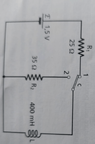
  • RL_circuit.png
    RL_circuit.png
    27.9 KB · Views: 130
Last edited:
  • Like
Likes   Reactions: Delta2
Physics news on Phys.org
You have the wrong expression for ##I(t)##. It does not predict that ##I(0) =0.06## A. What is the correct expression to use?

Also, please enter the exponent correctly in LaTeX as e^{-Rt/L} to render as ##e^{-Rt/L}##. Or you could write it as ##\exp(-R t/L)##.
 
Last edited:
  • Like
Likes   Reactions: lorenz0, berkeman, Steve4Physics and 1 other person
lorenz0 said:
(2) By setting ##I(t*)=0.06(1-e^((-35/0.4)t*))=35 mA## we get ##t*=\approx 0.01 s##
You have used the wrong formula! Can you see why? If you can't, click the spoiler for a hint:
When the switch has been at position 2 for a long time, do you expect the current through the inductor to be 0.06A?

Also, here's a LaTeX formatting hint:
e^(-R/L)t gives: ##e^(-R/L)t## (yuchy)
but
e^{(-R/L)t} gives: ##e^{(-R/L)t}## (slightly yuchy)
Another alternative is:
e^{-(R/L)t} gives: ##e^{-(R/L)t}## (almost not yuchy)

For zero-yuchiness, I would define the time-constant as ##\tau = \frac L R##. Then
e^{-\frac t {\tau}} gives: ##e^{-\frac t {\tau}}##.

Edit. @kuruman beat me to it or I would not have replied!
 
  • Like
Likes   Reactions: lorenz0, berkeman and kuruman
kuruman said:
You have the wrong expression for ##I(t)##. It does not predict that ##I(0) =0.06## A. What is the correct expression to use?

Also, please enter the exponent correctly in LaTeX as e^{-Rt/L} to render as ##e^{-Rt/L}##. Or you could write it as ##\exp(-R t/L)##.
I understand now, thanks. It should have been ##i(t)=0.06e^{-(R/L)t}## since, from time ##t=0## onwards, there isn't a battery connected to the "new" circuit anymore. By setting ##i(t^*)=35\cdot 10^{-3} A## I now get the correct value, thanks.
 
  • Like
Likes   Reactions: berkeman, kuruman and Steve4Physics

Similar threads

  • · Replies 1 ·
Replies
1
Views
845
Replies
6
Views
1K
  • · Replies 1 ·
Replies
1
Views
907
  • · Replies 8 ·
Replies
8
Views
2K
  • · Replies 10 ·
Replies
10
Views
2K
  • · Replies 18 ·
Replies
18
Views
3K
  • · Replies 5 ·
Replies
5
Views
1K
Replies
3
Views
1K
  • · Replies 2 ·
Replies
2
Views
958
Replies
7
Views
1K