Finding a closed form relation between rotating quadrant angles

  • Level: Graduate 
  • Thread starter bugatti79
  • Start date
  • Tags Tags
    Polynomial
2 replies · 2K views · last reply
bugatti79
Messages
786
Reaction score
4
TL;DR
establish connection between the 2 rotating quadrants
Hello All,

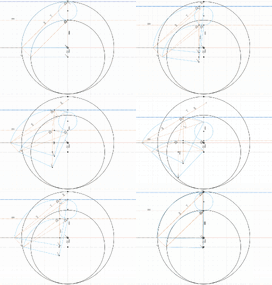
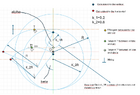
I struggled to find a closed form solution connecting the 2 quadrants via the angles alpha and beta. I filled the schematic with right angle triangles hoping to find a connection but to no avail.
In the end, I decided to create a polynomial function of beta in terms of alpha as I know the coordinates of the vertices. Could someone confirm that a closed form solution is not possible? Is there any way I could use a custom analytic function of beta in terms of alpha? Thanks!

CAD sketch of two circular arcs tangent to a vertical centre line, with dash-dot construction lines, dimension markers and a small circle at the top, drawn in a dark grey and blue sketch style.


Geometric construction of a mechanism with two circles of radii k_1R and k_2R, tangent lines and arcs, angles alpha and beta marked, and a 90 degree right-angle symbol, with a legend for coincident and tangent points.


CAD sketch of two circular arcs tangent to a vertical centre line, with dash-dot construction lines, dimension markers and a small circle at the top, drawn in a dark grey and blue sketch style.Geometric construction of a mechanism with two circles of radii k_1R and k_2R, tangent lines and arcs, angles alpha and beta marked, and a 90 degree right-angle symbol, with a legend for coincident and tangent points.
 
Last edited by a moderator:
I find the following relation between ##\alpha## and ##\beta##: $$\sin \beta = \frac 1 {K_2} \left( 1 - \cos \alpha + \sin \alpha \right).$$ See if you can confirm this using the method sketched below.

Geometric construction of two quadrant arcs with radii R and K_2R and a chord of length L from the left point to point A, with labelled points A to E, angles theta, phi, alpha and beta, and chord lengths L and L_2.

In the figure, ##L## and ##L_2## are the lengths of the chords of the two quadrants: ##L = \sqrt 2 R## and ##L_2 = \sqrt 2 K_2 R##.

##\theta## and ##\phi## denote the angles that the two chords make with respect to the horizontal. You can show that ##\theta = \pi/4 - \alpha## and ##\phi = \pi/4 - \beta##.

Thus, ##\sin \theta = (\cos \alpha – \sin\alpha)/\sqrt 2## and ##\sin \phi = (\cos \beta – \sin\beta)/\sqrt 2##.

##A, B, C, D, ## and ##E## label various points. Note that $$AC +CE = AB + BD +DE $$ where

##AC = L \sin \theta##

##CE = R – K_2 R##

##AB = 2K_1R##

##BD = K_2R(1-\cos \beta)##

##DE = L_2 \sin \phi##

Use these relations along with ##K_1 + K_2 = 1##.
 
Last edited:
  • Like
Likes   Reactions: Baluncore, bugatti79 and renormalize
Hallo TSny,

Indeed the equation you derived is correct and matches the angles calculated from the program/sketch. Many thanks for your input. I neglected to consider in futher detail the segments on the vertical axis.
Much appreciated and Thanks!
 
  • Like
Likes   Reactions: TSny, Baluncore and berkeman