Finding a Function for a Family of Curves

  • Context: Undergrad 
  • Thread starter Thread starter orthogonal
  • Start date Start date
  • Tags Tags
    Curve
Join the discussion
Registration is free. Ask a follow-up in this thread, or start your own.
4 replies · 2K views
orthogonal
Messages
10
Reaction score
0
Hey all,

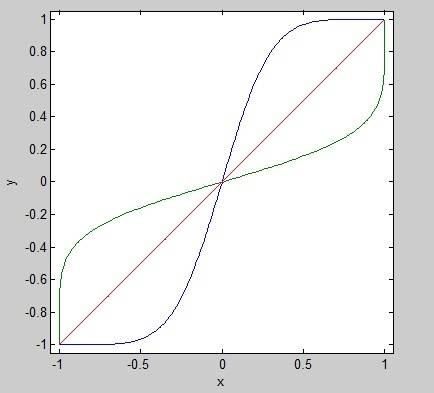
I am trying to find a function which will give me a family of curves similar to the one shown below. What I am hoping is that a single parameter will control whether the curve starts out slow (like the blue one) or whether the curve starts out fast (like the green one) or whether it is a linear ramp.

Does anyone know of a class of curves like this?

I can find plenty of curves which behave similar to the blue curve (ex. arctan, erf) but none like the green one.

Thanks,

Orthogonal
curves.jpg
 
Last edited:
Physics news on Phys.org
orthogonal said:
Hey all,

I am trying to find a function which will give me a family of curves similar to the one shown below. What I am hoping is that a single parameter will control whether the curve starts out slow (like the blue one) or whether the curve starts out fast (like the green one) or whether it is a linear ramp.

Does anyone know of a class of curves like this?

I can find plenty of curves which behave similar to the blue curve (ex. arctan, erf) but none like the green one.

Thanks,

Orthogonal

https://sites.google.com/site/rjaengineering/temp_pic/MWSnap%202014-04-02%2C%2016_34_19.bmp?attredirects=0
Your link is broken.
 
Fixed the link. :)
 
The green curve is the reflection over the line y=x of the blue curve. So if you have a function f(x) whose graph y = f(x) is the blue curve, then the graph of x = f(y) will give you the green curve. In other words, you want y = f-1(x), where f-1 is the inverse function of f, not its reciprocal.
So, for example, the functions f(x) = pi*arctan(x)/2 and f-1(x) = tan(x*pi/2) (restricted to the domain [-1, 1]) would be the type of pair you seek. These asymptotes may be a bit too slow for you, though.
In particular, you may want to use a scaled smooth transition function: http://en.wikipedia.org/wiki/Non-analytic_smooth_function#Smooth_transition_functions . Since it is 1-1 on the interval of transition, it is invertible there. Although both explicit forms may be aesthetically unpleasant.