Finding a substitution for a challenging integral

12 replies · 4K views · last reply
athrun200
Messages
275
Reaction score
0

Homework Statement


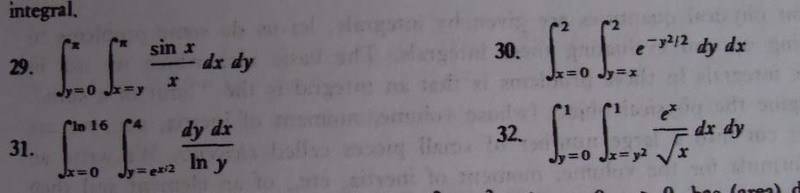
attachment.php?attachmentid=37197&stc=1&d=1310695247.jpg


Homework Equations


The Attempt at a Solution


Well, I just want some hint.
It seems substitution doesn't work.(I can't think of any suitable substitution)
 
Attachments
  • Four double integral problems numbered 29 to 32 from a calculus textbook page, with the heading 'integral.' above them: 29 has sin x over x dx dy, 30 has e to the power of minus y squared over 2 dy dx, 31 has dy dx over ln y, and 32 has e to the power of x over the square root of x dx dy.
    1.jpg
    12.7 KB · Views: 1,437
athrun200 said:

Homework Statement


Four double integrals numbered 29 to 32 from a printed calculus exercise set: 29 has sin x over x dx dy with y from 0 to x and x from y to pi; 30 has e to the power of minus y squared over 2 dy dx; 31 has dy dx over ln y with bounds up to ln 16 and e^(x/2) to 4; 32 has e^x over the square root of x dx dy.

Homework Equations


The Attempt at a Solution


Well, I just want some hint.
It seems substitution doesn't work.(I can't think of any suitable substitution)

These all seem to be like special functions, like for the first one, http://press.princeton.edu/books/maor/chapter_10.pdf however, you probably know that :x!
 
Last edited by a moderator:
Try changing the order of integration. Is that one of the subjects that is covered in the section of the textbook in which you found these problems?
 
SammyS said:
Try changing the order of integration. Is that one of the subjects that is covered in the section of the textbook in which you found these problems?

This chapter is about Multiple integrals, but it doesn't cover these special functions(Maybe the textbook assume we know these already).

It seems after changing the order, nothing change.
Take the first one as an example.
Handwritten double integral from x=0 to pi, inner integral over y from x to pi of sin x over x dy dx, followed by an equals sign and the single integral from x=0 to pi of sin x over x times (pi minus x) dx.
 
Attachments
  • Handwritten double integral from x=0 to π and y=x to π of sin x over x, dy dx, equals the single integral from x=0 to π of sin x over x times (π minus x), dx.
    1.jpg
    18.9 KB · Views: 1,412
Looking at problem 29. as it is given: [itex]\displaystyle \int_{y=0}^{\pi} \int_{x=y}^{\pi}\,\frac{\sin\,x}{x}\,dx\,dy\,,[/itex] what is the region over which the integration is to be done?

For any given y, x goes from the line x = y (the same as y = x) to the vertical line y = π. y goes from 0 (the x-axis) to π.

Therefore, this is the region in the xy-plane bounded by the x-axis, the line x = π and the line y = x.

That's not the same region you integrated over after you changed the order of integration. You integrated over the region bounded by the y-axis, the line y = π and the line y = x.

For the correct region, switching the order of integration will eliminate having to integrate "special functions".
 
SammyS said:
For the correct region, switching the order of integration will eliminate having to integrate "special functions".
Do this right, athrun200, and this same technique will apply to all four of those problems.
 
This may help for #29.
Plot of a shaded right triangle with vertices near (0,0), (π,0) and (π,π) on axes labelled x from 0 to 4 and y from 0 to 4.
 
Attachments
  • Graph on x and y axes from 0 to 4 showing a shaded right triangle with vertices near (0,0), (3.1,0) and (3.1,3.1), filled in light blue.
    MSP45119g9fdcf080fb7e100004h079254eg931406.gif
    1.9 KB · Views: 606
SammyS said:
Looking at problem 29. as it is given: [itex]\displaystyle \int_{y=0}^{\pi} \int_{x=y}^{\pi}\,\frac{\sin\,x}{x}\,dx\,dy\,,[/itex] what is the region over which the integration is to be done?

For any given y, x goes from the line x = y (the same as y = x) to the vertical line y = π. y goes from 0 (the x-axis) to π.

Therefore, this is the region in the xy-plane bounded by the x-axis, the line x = π and the line y = x.

That's not the same region you integrated over after you changed the order of integration. You integrated over the region bounded by the y-axis, the line y = π and the line y = x.

For the correct region, switching the order of integration will eliminate having to integrate "special functions".


While I'm not the OP, I have to say thanks as that is a cool technique that I did not know of! Thanks!
 
D H said:
Excellent. You got all three.

I am so happy that I understand this section now:biggrin:
 
athrun200 & romsofia,

Glad that you now understand this.D H,
Thanks for checking in on these problems! I'm traveling & have been away from computer access for a few days.
 
Last edited by a moderator: