Finding Angle at $\gamma$ - Help Requested

  • Context: MHB 
  • Thread starter Thread starter Carla1985
  • Start date Start date
  • Tags Tags
    Angle
Click For Summary
SUMMARY

The discussion centers on determining the angle at $\gamma$ using the vertical angles theorem. The user initially struggles to identify the correct theorem but ultimately confirms that $\gamma$ represents the angle formed by two intersecting lines. The clarification that $\gamma$ is indeed an angle between these lines simplifies the problem, leading to a resolution with the application of the vertical angles theorem.

PREREQUISITES
  • Understanding of basic geometric concepts, specifically angles and lines.
  • Familiarity with the vertical angles theorem.
  • Knowledge of circle geometry and angle relationships.
  • Ability to visualize geometric figures and their properties.
NEXT STEPS
  • Study the properties of vertical angles in more depth.
  • Explore the relationship between angles formed by intersecting lines and circles.
  • Learn about other relevant theorems in circle geometry, such as the inscribed angle theorem.
  • Practice solving problems involving angles and their relationships in various geometric configurations.
USEFUL FOR

Students studying geometry, educators teaching geometric principles, and anyone seeking to enhance their understanding of angle relationships in geometric figures.

Carla1985
Messages
91
Reaction score
0
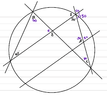
View attachment 6256
Hi,

could someone please tell me what theorem I need to be looking at to work out the angle at $\gamma$ please? I've worked out the rest but can't find a theorem for this one.

Thanks
 

Attachments

  • General - 20161101_20115 p.m. - 10.png
    General - 20161101_20115 p.m. - 10.png
    26.7 KB · Views: 90
Mathematics news on Phys.org
Use the vertical angles theorem.
 
Euge said:
Use the vertical angles theorem.

Thanks but that just gives me the angle between the two straight lines. My impression was that $\gamma$ was the part of the angle up to the edge of the circle.
 
That would not make an angle, for an angle is formed by two straight lines. It would only make sense for $gamma$ to be the angle between those two lines.
 
Euge said:
That would not make an angle, for an angle is formed by two straight lines. It would only make sense for $gamma$ to be the angle between those two lines.

That would make things a whole lot easier. Thank you for your help!
 

Similar threads

  • · Replies 1 ·
Replies
1
Views
1K
  • · Replies 4 ·
Replies
4
Views
2K
  • · Replies 5 ·
Replies
5
Views
1K
  • · Replies 21 ·
Replies
21
Views
4K
Replies
1
Views
2K
  • · Replies 1 ·
Replies
1
Views
2K
  • · Replies 1 ·
Replies
1
Views
1K
  • · Replies 7 ·
Replies
7
Views
2K
  • · Replies 8 ·
Replies
8
Views
3K
  • · Replies 2 ·
Replies
2
Views
1K