Samwise-zambeezi
- 6
- 0
Hi guys!
I've got a problem with a triangle, and I'm frazzled my brain trying to work it out (not even sure if what I'm looking for is possible with the info I have!).
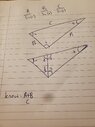
Pic of the offending triangle attached.
Basically, I know the length of C and the sum of lengths A and B.
Now, if C was static and remained unchanged, but if the point c was to move, lengths A and B would change. I'm trying to find the individual lengths of A and B at the point at which, C is split with a vertical into two equal angles (f and g).
Is this possible? Hope this is clear enough, any tips would be a massive help.
Best regards
Swise
I've got a problem with a triangle, and I'm frazzled my brain trying to work it out (not even sure if what I'm looking for is possible with the info I have!).
Pic of the offending triangle attached.
Basically, I know the length of C and the sum of lengths A and B.
Now, if C was static and remained unchanged, but if the point c was to move, lengths A and B would change. I'm trying to find the individual lengths of A and B at the point at which, C is split with a vertical into two equal angles (f and g).
Is this possible? Hope this is clear enough, any tips would be a massive help.
Best regards
Swise