Finding distance between Earth and Moon in gravitational fields

Click For Summary
SUMMARY

The discussion focuses on calculating the distance between the Earth and the Moon, assuming a circular orbit with a period of 27.5 days and the Earth's mass as 6.0 × 1024 kg. The second question explores the jump height on a planet with half the Earth's radius but the same density, concluding that gravitational acceleration is proportional to the radius for a constant density. The relationship between gravitational acceleration and radius is established through the formula g = (4/3)GπρR, indicating that g2 will be half of g1.

PREREQUISITES
  • Understanding of gravitational force and acceleration
  • Familiarity with circular motion and orbital mechanics
  • Knowledge of basic physics formulas, particularly g = (4/3)GπρR
  • Concept of density in relation to planetary bodies
NEXT STEPS
  • Research the derivation of gravitational force equations in circular orbits
  • Explore the implications of varying planetary radii on gravitational acceleration
  • Study the relationship between density and gravitational force in astrophysics
  • Learn about the effects of gravity on human physiology during jumps on different celestial bodies
USEFUL FOR

Students of physics, astrophysicists, and anyone interested in gravitational effects on planetary bodies and human movement in varying gravitational fields.

Bolter
Messages
262
Reaction score
31
Homework Statement
Calculate the distance between 2 masses in a gravitational field

Calculate the height reached when a person jumps on a planet
Relevant Equations
Orbital period
gravitational field strength
Here are 2 questions that I have tried to answer and was hoping if these are right ways to go about it?

Q1) Find the distance in meters (m) between centre of the Moon and the centre of the Earth, assuming that the Moon moves in a circular orbit with a period of 27.5 days. Take the mass of the Earth as 6.0 × 10^24 kg. Assume that the distance between the Earth and the Moon is much larger than the radii of both planets
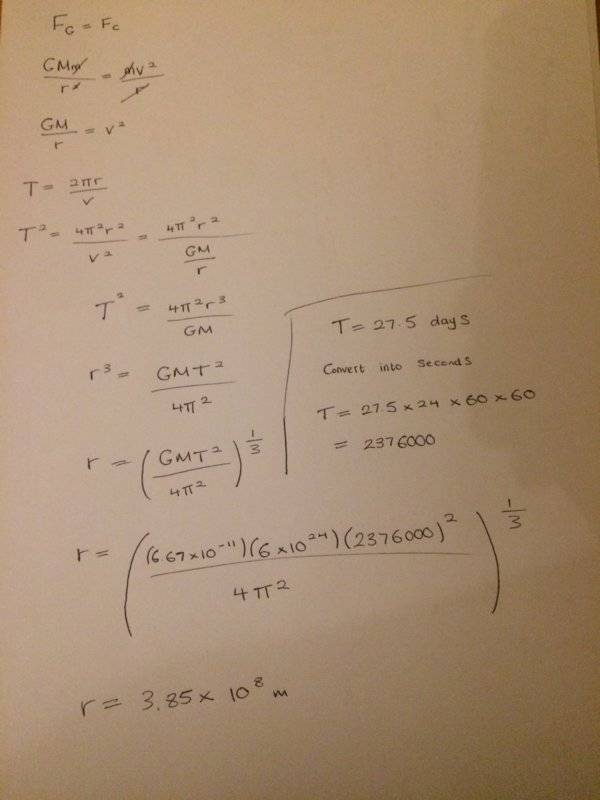
IMG_3759.JPG


Q2) If a person can jump a vertical height of 1.3 m on the Earth, how high could he jump (applying the same effort as on the Earth) on a planet with the same density as the Earth, but only half the radius.
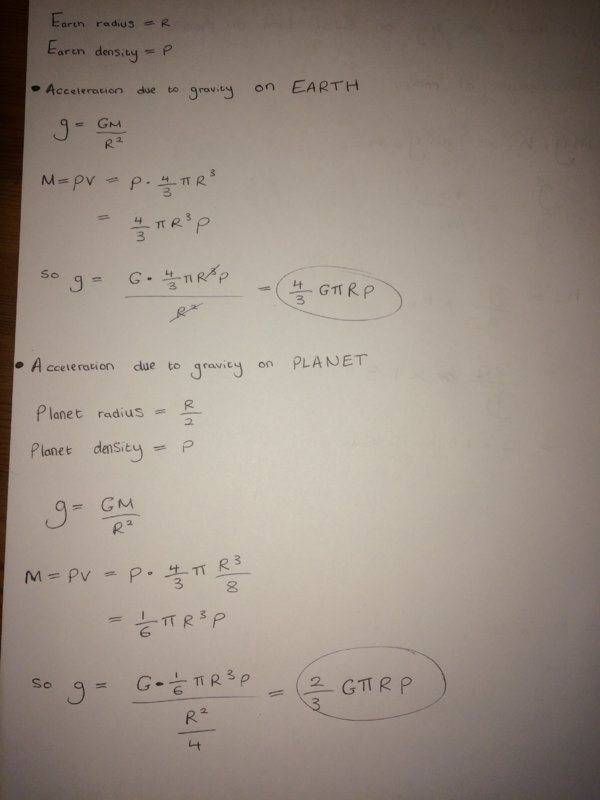
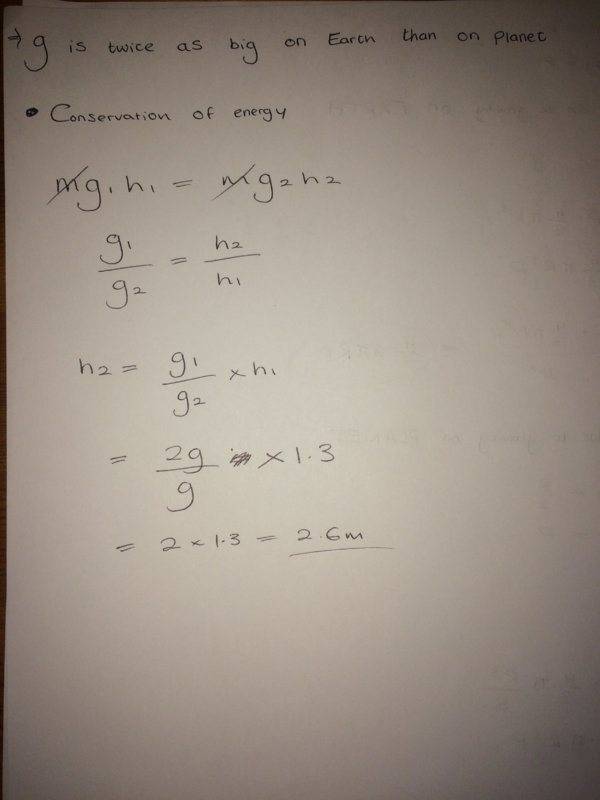
IMG_3751.JPG


IMG_3752.JPG


Any help would be appreciated! Thanks
 
Physics news on Phys.org
Your work looks good to me.
 
  • Like
Likes   Reactions: Bolter
gneill said:
Your work looks good to me.

Ok thank you so much
 
Looks good to me, too. Note that once you have the expression ##g = \frac{4}{3}G \pi \rho R## you can see that ##g## is just proportional to ##R## for fixed ##\rho##. So, you can see ##g_2## will be half of ##g_1##.
 
  • Like
Likes   Reactions: Bolter
TSny said:
Looks good to me, too. Note that once you have the expression ##g = \frac{4}{3}G \pi \rho R## you can see that ##g## is just proportional to ##R## for fixed ##\rho##. So, you can see ##g_2## will be half of ##g_1##.

Ah yes I can see this relationship, much easier to use the proportionality relationship then to identify how much bigger or smaller g1 will be to g
 
Bolter said:
Ah yes I can see this relationship, much easier to use the proportionality relationship then to identify how much bigger or smaller g1 will be to g
You are learning to think like a physicist. :oldsmile:
 

Similar threads

  • · Replies 12 ·
Replies
12
Views
2K
Replies
21
Views
3K
Replies
2
Views
2K
  • · Replies 5 ·
Replies
5
Views
2K
  • · Replies 73 ·
3
Replies
73
Views
5K
  • · Replies 4 ·
Replies
4
Views
2K
Replies
1
Views
2K
  • · Replies 18 ·
Replies
18
Views
2K
  • · Replies 5 ·
Replies
5
Views
2K
  • · Replies 11 ·
Replies
11
Views
2K