Finding eigenvalues and eigenvectors given sub-matrices

Click For Summary
SUMMARY

This discussion focuses on the derivation of eigenvalues and eigenvectors from sub-matrices, specifically addressing how to express eigenvectors in terms of a scalar multiple, t. The participants confirm that if a vector v is an eigenvector of matrix A with eigenvalue λ, then t*v is also an eigenvector for any non-zero scalar t. The conversation highlights the conditions under which multiple eigenvalues and corresponding eigenvectors exist, particularly noting the case when a = -1 results in a unique eigenvalue with all vectors being eigenvectors.

PREREQUISITES
  • Understanding of eigenvalues and eigenvectors
  • Familiarity with linear algebra concepts
  • Knowledge of matrix operations
  • Basic understanding of scalar multiplication in vector spaces
NEXT STEPS
  • Study the properties of eigenvalues and eigenvectors in linear transformations
  • Learn about the characteristic polynomial and its role in finding eigenvalues
  • Explore the implications of eigenvalues in systems of differential equations
  • Investigate the relationship between eigenvectors and matrix diagonalization
USEFUL FOR

Mathematicians, students of linear algebra, and anyone involved in computational mathematics or engineering applications requiring eigenvalue analysis.

member 731016
Homework Statement
Please see below
Relevant Equations
Please see below
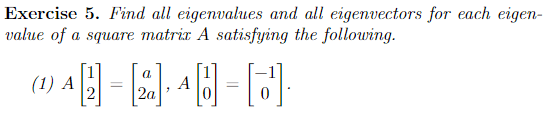
For this,
1685494468803.png

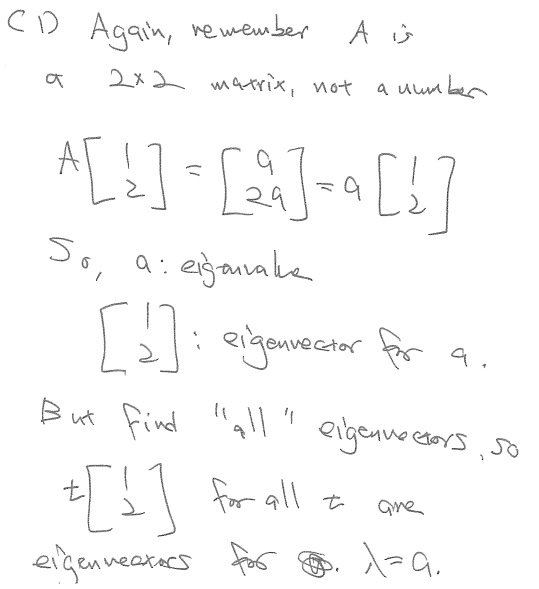
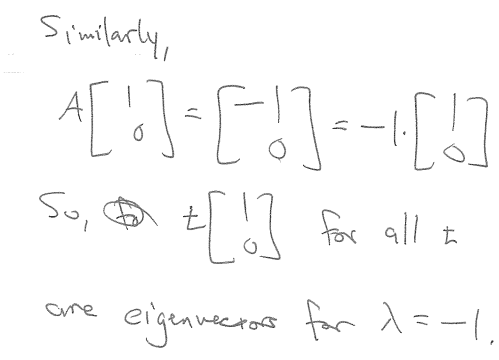
The solution is,
1685494576554.png

1685494595484.png

However, does someone please know what allows them to express the eigenvector for each of the sub-matrix in terms of t?

Many thanks!
 
Physics news on Phys.org
From the definition a multiple of any eigenvector is also trivially an eigenvector. So who did this?
 
  • Like
Likes   Reactions: member 731016
Any matrix operator is linear. So ##A (tv)= t A v ## for any vector, ##v##.
Now use that in your case with the eigenvector and eigenvalue.
 
Last edited:
  • Like
Likes   Reactions: member 731016
You need to take into account that both conditions hold. If ##a\not = -1##, then there are two eigenvalues and the corresponding eigenvectors are multiples of the two given vectors. If ##a=-1##, then there is only one eigenvalue and all vectors are eigenvectors.
 
  • Like
Likes   Reactions: member 731016
Thank you for your replies @hutchphd, @FactChecker and @martinbn !

So I am coming to think of it like this considering the most general case I could think of:

##A\vec v = \lambda\vec v##
##At\vec v = \lambda t\vec v## multiply both sides by a scalar ##t## which is a member of the reals
Therefore, the definition of eigenvector and eigenvalue, ##t\vec v## is an eigenvectors for ##\lambda## and ##\lambda## is the eigenvalue for A.

Is that please correct?

Many thanks!
 
ChiralSuperfields said:
##A\vec v = \lambda\vec v##
##At\vec v = \lambda t\vec v## multiply both sides by a scalar ##t## which is a member of the reals
Therefore, the definition of eigenvector and eigenvalue, ##t\vec v## is an eigenvectors for ##\lambda## and ##\lambda## is the eigenvalue for A.

Is that please correct?
Yes, but it would be better if you rephrased your statement to more clearly match the definition of an eigenvector and eigenvalue:
Suppose ##\lambda## and ##\vec v## are eigenvalue and eigenvector of ##A##, respectively. For any ##t \in \mathbb{R}##, where ##t \ne 0##, ##A( \vec {tv}) = t A\vec v = t \lambda \vec v = \lambda \vec {tv}##. So ##\vec {tv}## is also an eigenvector of ##A## with the eigenvalue ##\lambda##.
 
  • Like
  • Informative
Likes   Reactions: hutchphd and member 731016
FactChecker said:
Yes, but it would be better if you rephrased your statement to more clearly match the definition of an eigenvector and eigenvalue:
Suppose ##\lambda## and ##\vec v## are eigenvalue and eigenvector of ##A##, respectively. For any ##t \in \mathbb{R}##, where ##t \ne 0##, ##A( \vec {tv}) = t A\vec v = t \lambda \vec v = \lambda \vec {tv}##. So ##\vec {tv}## is also an eigenvector of ##A## with the eigenvalue ##\lambda##.
Thank you for your help @FactChecker!
 
ChiralSuperfields said:
Thank you for your help @FactChecker!
Actually, I realize that your statement did match the definitions of eigenvector and eigenvalue, but I think that I have rephrased it more as a step-by-step proof.
 
  • Like
Likes   Reactions: member 731016
FactChecker said:
Actually, I realize that your statement did match the definitions of eigenvector and eigenvalue, but I think that I have rephrased it more as a step-by-step proof.
Thank you for your reply @FactChecker! Yeah I only just realized the definition of eigenvector is for a value of ##\lambda## not the matrix A too!
 
  • #10
ChiralSuperfields said:
Thank you for your reply @FactChecker! Yeah I only just realized the definition of eigenvector is for a value of ##\lambda## not the matrix A too!
It's for the combination of the matrix, ##A##, and the eigenvalue ##\lambda##
 
  • Like
Likes   Reactions: member 731016
  • #11
FactChecker said:
It's for the combination of the matrix, ##A##, and the eigenvalue ##\lambda##
Oh, thank you for you letting me know @FactChecker !
 

Similar threads

Replies
8
Views
2K
  • · Replies 7 ·
Replies
7
Views
2K
  • · Replies 3 ·
Replies
3
Views
2K
  • · Replies 2 ·
Replies
2
Views
2K
Replies
11
Views
2K
  • · Replies 4 ·
Replies
4
Views
1K
Replies
9
Views
2K
  • · Replies 6 ·
Replies
6
Views
2K
  • · Replies 5 ·
Replies
5
Views
2K
  • · Replies 19 ·
Replies
19
Views
4K