Finding eigenvalues and eigenvectors given sub-matrices

10 replies · 2K views · last reply
member 731016
Homework Statement
Please see below
Relevant Equations
Please see below
For this,
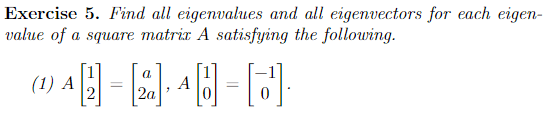
Exercise 5 text: Find all eigenvalues and all eigenvectors for each eigenvalue of a square matrix A satisfying the following. Part (1): A times the column vector (1, 2) equals the column vector (a, 2a), and A times the column vector (1, 0) equals the column vector (-1, 0).

The solution is,
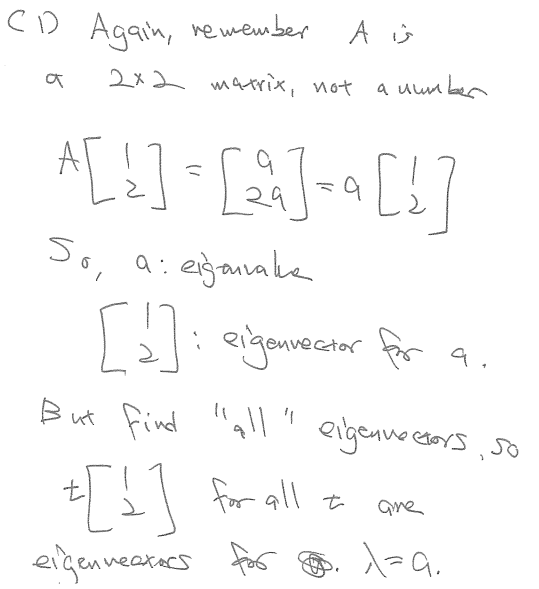
Handwritten working on eigenvalues: A is a 2x2 matrix, not a number. A times the column vector (1, 2) equals the column vector (9, 18), which is 9 times (1, 2), so 9 is an eigenvalue with eigenvector (1, 2). Then t times (1, 2) is an eigenvector for lambda = 9.

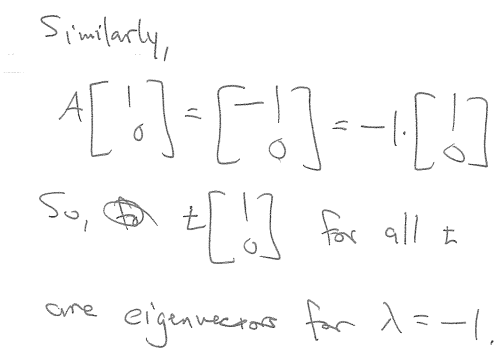
Handwritten derivation: Similarly, A [1; 0] = [-1; 0] = -1 times [1; 0]. So t [1; 0] for all t are one eigenvector for lambda = -1.

However, does someone please know what allows them to express the eigenvector for each of the sub-matrix in terms of t?

Many thanks!
 
From the definition a multiple of any eigenvector is also trivially an eigenvector. So who did this?
 
  • Like
Likes   Reactions: member 731016
Any matrix operator is linear. So ##A (tv)= t A v ## for any vector, ##v##.
Now use that in your case with the eigenvector and eigenvalue.
 
Last edited:
  • Like
Likes   Reactions: member 731016
You need to take into account that both conditions hold. If ##a\not = -1##, then there are two eigenvalues and the corresponding eigenvectors are multiples of the two given vectors. If ##a=-1##, then there is only one eigenvalue and all vectors are eigenvectors.
 
  • Like
Likes   Reactions: member 731016
Thank you for your replies @hutchphd, @FactChecker and @martinbn !

So I am coming to think of it like this considering the most general case I could think of:

##A\vec v = \lambda\vec v##
##At\vec v = \lambda t\vec v## multiply both sides by a scalar ##t## which is a member of the reals
Therefore, the definition of eigenvector and eigenvalue, ##t\vec v## is an eigenvectors for ##\lambda## and ##\lambda## is the eigenvalue for A.

Is that please correct?

Many thanks!
 
ChiralSuperfields said:
##A\vec v = \lambda\vec v##
##At\vec v = \lambda t\vec v## multiply both sides by a scalar ##t## which is a member of the reals
Therefore, the definition of eigenvector and eigenvalue, ##t\vec v## is an eigenvectors for ##\lambda## and ##\lambda## is the eigenvalue for A.

Is that please correct?
Yes, but it would be better if you rephrased your statement to more clearly match the definition of an eigenvector and eigenvalue:
Suppose ##\lambda## and ##\vec v## are eigenvalue and eigenvector of ##A##, respectively. For any ##t \in \mathbb{R}##, where ##t \ne 0##, ##A( \vec {tv}) = t A\vec v = t \lambda \vec v = \lambda \vec {tv}##. So ##\vec {tv}## is also an eigenvector of ##A## with the eigenvalue ##\lambda##.
 
  • Like
  • Informative
Likes   Reactions: hutchphd and member 731016
FactChecker said:
Yes, but it would be better if you rephrased your statement to more clearly match the definition of an eigenvector and eigenvalue:
Suppose ##\lambda## and ##\vec v## are eigenvalue and eigenvector of ##A##, respectively. For any ##t \in \mathbb{R}##, where ##t \ne 0##, ##A( \vec {tv}) = t A\vec v = t \lambda \vec v = \lambda \vec {tv}##. So ##\vec {tv}## is also an eigenvector of ##A## with the eigenvalue ##\lambda##.
Thank you for your help @FactChecker!
 
ChiralSuperfields said:
Thank you for your help @FactChecker!
Actually, I realize that your statement did match the definitions of eigenvector and eigenvalue, but I think that I have rephrased it more as a step-by-step proof.
 
  • Like
Likes   Reactions: member 731016
FactChecker said:
Actually, I realize that your statement did match the definitions of eigenvector and eigenvalue, but I think that I have rephrased it more as a step-by-step proof.
Thank you for your reply @FactChecker! Yeah I only just realized the definition of eigenvector is for a value of ##\lambda## not the matrix A too!
 
ChiralSuperfields said:
Thank you for your reply @FactChecker! Yeah I only just realized the definition of eigenvector is for a value of ##\lambda## not the matrix A too!
It's for the combination of the matrix, ##A##, and the eigenvalue ##\lambda##
 
  • Like
Likes   Reactions: member 731016