Finding Force Given Potential Energy

Click For Summary
SUMMARY

This discussion focuses on calculating force from potential energy using the equation V(r; C6, C12) = C12/r12 - C6/r6, with constants C12 = 1.0 and C6 = 2.0. The participants clarify that the force vector F is derived from the negative gradient of the potential energy function, expressed as F(vector) = -∇V. The correct approach involves taking the partial derivative of V with respect to r and simplifying the resulting expression by substituting the values of C6 and C12. The final force calculation yields approximately -7.997 x 10^-6 Newtons.

PREREQUISITES
  • Understanding of vector calculus, particularly gradients
  • Familiarity with potential energy concepts in physics
  • Knowledge of unit vectors and their notation
  • Ability to perform partial derivatives
NEXT STEPS
  • Study the concept of gradients in vector calculus
  • Learn about potential energy functions and their applications in physics
  • Explore the use of unit vectors in multi-variable calculus
  • Practice deriving force equations from potential energy in various contexts
USEFUL FOR

Students in physics courses, particularly those studying mechanics and vector calculus, as well as educators seeking to clarify concepts related to force and potential energy calculations.

CallMeShady
Messages
45
Reaction score
1
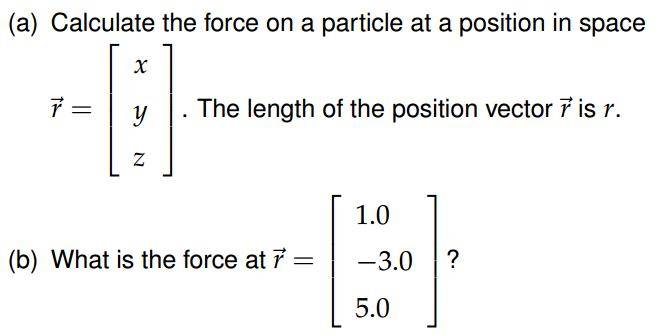
Now let me start off by saying that I, along with over 100 students in my class are having issues with this concept, thanks to our "amazing" professor, while our midterm exam is a few days away. I don't want to sound like I am complaining, but I am frustrated with the fact that the professor refuses to go over an example with us completely. The following is a practice exam question and for some reason, he refuses to provide answers to the questions (forget providing an answer key). Any help would be greatly appreciated.

Homework Statement


V(r; C6, C12) = C12/r12 - C6/r6 with C12 = 1.0 and C6 = 2.0
2vdinf7.jpg


Homework Equations


None, all equations you need for the question are in the question itself.


The Attempt at a Solution


So I know that F(vector) = -∇V, where F is the force and V is the potential energy. Basically this means that I need to take the partial derivative of V(r) and multiply that by r(vector)/r and so for part (a), I get: (12C12r-13-6C6r-7)(r(vector)/r)
Have I done this correct? And if so, how do I proceed to part (b)?
 
Physics news on Phys.org
You are correct in part a, but you can simplify the answer a little.
What is the relation between r,r(vector) and x,y,z,x^,y^,z^?
 
frogjg2003 said:
You are correct in part a, but you can simplify the answer a little.
What is the relation between r,r(vector) and x,y,z,x^,y^,z^?

By simplifying the answer, do you mean just substitute the values of C6 and C12 with their respective values (given in the question)?

In addition, I know that r(vector)/r is just a normalized vector. In other words, it gives me the direction of the vector force. In addition, r = √x2+y2(+z2). However, I still do not know how to solve part (b). I can't seem to put my ideas together.
 
By simplify, I just meant multiply r^-13 and r^-12 by the 1/r you had grouped with r(vector).

Ok, you have r^2=x^2+y^2+z^2, what about r(vector)?
 
By multiplying the derived equation by 1/r, I get:
(12C12r-14-6C6r-8)(r(vector))

And since r = √x2+y2(+z2), I get:
(12C12(√x2+y2+z2)-14-6C6(√x2+y2+z2)-8)(r(vector))

Finally r(vector) gives me the exact location using the x,y,z co-ordinates. So, now, do I just substitute the values of x,y,z given by r(vector) into the equation above?
 
Last edited:
Yes
quick note: Sqrt(...)^-14 and Sqrt(...)^-8 simplify
 
Hm, by simplifying, do you mean that they become:
(x2+y2+z2)-7
&
(x2+y2+z2)-4
?
 
Yes.
As for plugging in, remember that \vec{r}=x\hat{x}+y\hat{y}+z\hat{z}
 
I am not sure what you mean with that equation above... what does the hat above the variables mean?

After substituting the numbers, I got r = √35 and plugging that into the original derived equation, I got an answer of -7.997 \times10-6 (which I am assuming is an answer in Newtons).
 
  • #10
\hat{x}, \hat{y}, \hat{z} are the unit vectors in the x,y, and z directions. If you haven't seen this notation yet, you are overdue. It's just a way of writing out a vector as a sum of terms instead of as a matrix, which has the benefit of being very useful for multi-variable calculus. I don't know how you're doing gradients without having seen unit vectors yet.
 

Similar threads

Replies
15
Views
2K
  • · Replies 14 ·
Replies
14
Views
1K
  • · Replies 7 ·
Replies
7
Views
1K
Replies
9
Views
932
Replies
4
Views
1K
  • · Replies 22 ·
Replies
22
Views
4K
  • · Replies 23 ·
Replies
23
Views
2K
Replies
1
Views
3K
  • · Replies 15 ·
Replies
15
Views
2K