Finding Impulse and Velocity from Force vs. Time Graph

Click For Summary
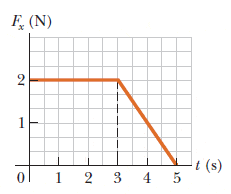
The discussion focuses on calculating impulse and final velocity from a force vs. time graph for a 1.7 kg object. Participants clarify that impulse can be found using the area under the force vs. time graph, which equals force multiplied by time. It is emphasized that this graph does not represent acceleration vs. time, and thus the area does not directly provide final velocity. The impulse-momentum theorem is suggested as a useful approach for solving the problem. Overall, understanding the relationship between force, time, and impulse is key to finding the required values.
MG5
Messages
60
Reaction score
0
Heres the graph.

6-p-015.gif


Heres the problem

Mass of the object is 1.7 kg.

(a) Find the impulse of the force.


(b) Find the final velocity of the object if it is initially at rest.


(c)Find the final velocity of the object if it is initially moving along the x-axis with a velocity of
−1.9 m/s.

Wouldn't the velocity be the area under the graph be the velocity?
 
Physics news on Phys.org
MG5 said:
Heres the graph.

6-p-015.gif


Heres the problem

Mass of the object is 1.7 kg.

(a) Find the impulse of the force.

(b) Find the final velocity of the object if it is initially at rest.

(c)Find the final velocity of the object if it is initially moving along the x-axis with a velocity of
−1.9 m/s.

Wouldn't the velocity be the area under the graph be the velocity?
No.

It's not an acceleration vs time graph.
 
Why don't you show us what you did and where you're stuck on a, b, and c.
 
howie8594 said:
Why don't you show us what you did and where you're stuck on a, b, and c.

Don't even know where to start.
 
MG5 said:
Don't even know where to start.
Well, you could use the impulse-momentum theorem.

Or

How is the graph related to an acceleration vs. time graph?
 
If you want to find the impulse, it's force * time. Look at your graph again. It alone should be enough to find the impulse. The area of the graph does not represent the final velocity.
 
The book claims the answer is that all the magnitudes are the same because "the gravitational force on the penguin is the same". I'm having trouble understanding this. I thought the buoyant force was equal to the weight of the fluid displaced. Weight depends on mass which depends on density. Therefore, due to the differing densities the buoyant force will be different in each case? Is this incorrect?

Similar threads

Replies
7
Views
2K
  • · Replies 2 ·
Replies
2
Views
4K
  • · Replies 17 ·
Replies
17
Views
4K
  • · Replies 2 ·
Replies
2
Views
2K
Replies
1
Views
3K
  • · Replies 19 ·
Replies
19
Views
3K
Replies
3
Views
4K
Replies
57
Views
3K
  • · Replies 9 ·
Replies
9
Views
3K
Replies
14
Views
3K