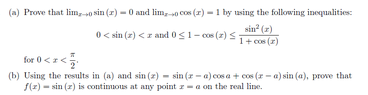
I presume you have already shown that [tex]\lim_{x\to 0} sin(x)= 0[/tex]. So focus on [tex]0\le 1- cos(x)\le \frac{sin^2(x)}{1+ cos(x)}[/tex]. Assume, for the moment, that [tex]\lim_{x\to 0} cos(x)[/tex] exists and is equal to "A". Then, taking the limit of each part as x goes to 0, we have [tex]0\le 1- A\le \frac{0}{1+ A}[/tex] so [tex]0\le 1- A\le 0[/tex]. What is "A"?
For (b), if you let u= x- a then the expression becomes "sin(x- a)= sin(u)cos(a)- sin(a)cos(u)" and taking the limit as x goes to a is the same as taking the limit as u goes to 0.