Finding net force using velocity graph?

Click For Summary
SUMMARY

The discussion focuses on calculating the net force acting on a 2.5 kg object using its velocity graph. The correct approach involves determining acceleration by plotting it against time, specifically using the formula \( a_x = \frac{dv_x}{dt} \). The participant initially miscalculated the acceleration as -2 m/s² but later corrected it to -6 m/s², leading to the accurate force calculation of 15 N using \( F = ma \). The key takeaway is that the force remains constant due to linear changes in velocity over specified time intervals.

PREREQUISITES
  • Understanding of Newton's Second Law (F=ma)
  • Basic knowledge of kinematics, specifically velocity and acceleration
  • Ability to interpret and plot graphs
  • Familiarity with the concept of momentum
NEXT STEPS
  • Learn how to derive acceleration from velocity graphs
  • Study the relationship between force, mass, and acceleration in various contexts
  • Explore the concept of momentum and its implications in physics
  • Investigate linear motion and its graphical representations
USEFUL FOR

Students studying physics, educators teaching kinematics, and anyone interested in understanding the principles of force and motion through graphical analysis.

jennaskim
Messages
7
Reaction score
0
Finding net force using velocity graph?

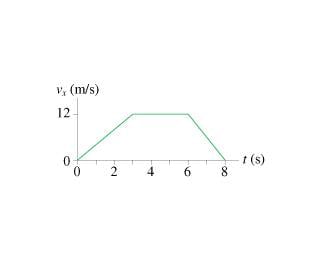
The figure(Figure 1) shows the velocity graph of a 2.5object as it moves along the x-axis.

06.EX08.jpg


What is the net force acting on this object at t=7 ?


The attempt at a solution

Since F=ma, I tried first finding a by dividing 6 m by 7 s. Then I got 0.857 m/s2 x 2.5 kg = 2.1429 ≈ 2.1 ...but it's wrong :(

Please help.
 
Physics news on Phys.org


What you need to do is plot acceleration on the same graph. Acceleration = ax*dvx/dt. So at first the particle accelerates positively a certain amount (how much?), then stops accelerating, then accelerates negatively another certain amount (again, how much?).

Now, keeping in mind Fx = max, read off ax on your newly created chart and use this formula.

What comment might you have regarding the ax graph for x < 6 s?


I got a= -2 at t = 7.
I did F = 2.5 x 2 = 5.0 ...It's still wrong


jennaskim said:
I got a= -2 at t = 7.
I did F = 2.5 x 2 = 5.0 ...It's still wrong

How did you get a = -2 at t = 7? That's really off.


Nevermind. I think it's a = 6? I took the slope = 12 / 2 = 6


correction: -6 ?


I used a = -6, and i got the right answer! Thanks for you help


Force is a change in momentum, the momentum changes for the first 3s and the last 2s - The force is constant since the decrease in velocity is linear. Find the change in velocity over the period of time when you know the momentum is changing, then you get the force. You know this is exact since the change in velocity throughout each time period is constant (not changing) - i.e. it is not an approximation.
 

Similar threads

Replies
10
Views
1K
Replies
6
Views
2K
  • · Replies 6 ·
Replies
6
Views
2K
Replies
30
Views
4K
Replies
14
Views
3K
  • · Replies 21 ·
Replies
21
Views
1K
  • · Replies 41 ·
2
Replies
41
Views
4K
  • · Replies 2 ·
Replies
2
Views
2K
  • · Replies 4 ·
Replies
4
Views
3K
  • · Replies 10 ·
Replies
10
Views
2K