OK, I think we need to do a restart on this problem. I will begin with a new 3D picture of just the first octant portion of this problem.
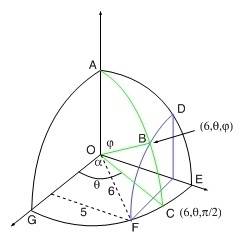
I have indicated a general ##\theta## and the green lines are in the plane generated by that ##\theta## as ##\phi## and ##\rho## vary. Note that as ##\phi## varies from ##0## to ##\pi /2## the end of the ##\rho=6## line sweeps along the green arc ABC. Point B is the place where ##\phi## begins to hit the part of the sphere to the right of ##y=5##. The plane ##y=5## is outlined with the purple lines. Notice that if ##\theta## were ##\pi / 2## then ##\phi## would only sweep out the arc AD before hitting the plane ##y=5##. That is a shorter arc than AB so the lowest value of ##\phi## to hit the plane depends on ##\theta##. To get the relation between ##\phi## and ##\theta##, look at the point ##B =(6,\theta,\phi)##. That point lies on the plane ##y=5##. The spherical coordinate equation for ##y## in general is ##y=\rho\sin\phi\sin\theta##. Applying that to this point gives ##5 = 6\sin\phi\sin\theta## so ##\sin\phi =\frac 5 {6\sin\theta}##. So, finally, the dependence of ##\phi## on ##\theta## is$$
\phi = \arcsin\left(\frac 5 {6\sin\theta}\right)$$So, in this picture, depending on what ##\theta## is, we would have$$
\arcsin\left(\frac 5 {6\sin\theta}\right)\le \phi \le \frac \pi 2$$Of course, for the full problem, ##\phi## wouldn't stop at ##\pi /2##.
In the picture, ##\alpha##, which is angle GOF in the xy plane, would be the min value of ##\theta## and its max would be ##\pi/2##, but it wouldn't stop there for the non-first octant part. I have deliberately not done more than the first octant to leave the OP something to do, yet I pretty much couldn't do less and explain the problem clearly.
BUT, and this is the real lesson here, while this is a great exercise for doing complicated limits and gives a perfectly good parameterization, it is NOT the best way to work this problem.
To see this, think about how much simpler this problem would have been if it had asked for the parameterization of the part of the sphere above the plane ##z=5## instead of to the right of the plane ##y=5##. If you set that problem up in spherical coordinates, the ##\theta## and ##\phi## limits are easy, constant, and don't depend on each other. So think about solving that problem. Once you have that solved, you only have to rename the variables so instead of using the ##z## axis for the azimuth angle, use the ##y## axis.