Finding resistor's voltage with current and voltage sources present

Click For Summary
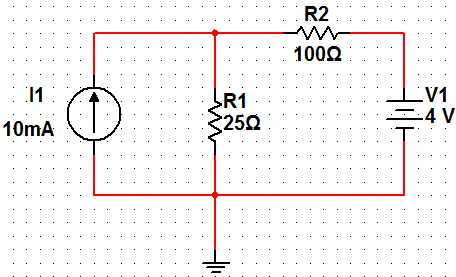
To find the voltage across resistor R2 in a circuit with both current and voltage sources, first convert the 4 V source and R2 into a current source, resulting in I_2 of 40 mA. Combining this with the existing current source I_1 gives a total current of 50 mA. Using the current divider rule, the current through R2 is calculated to be 10 mA, leading to an initial voltage across R2 of 1 V. However, simulations indicate a voltage of 3 V across R2, which is confirmed by analyzing the original circuit and applying Kirchhoff's Voltage Law, revealing that the voltage across R2 is indeed 3 V after accounting for the voltage drop across R1.
JJBladester
Gold Member
Messages
281
Reaction score
2
What is the voltage across R2? You should convert the 4 V source and resistor into a current source as your first step.
current_and_voltage_source.png


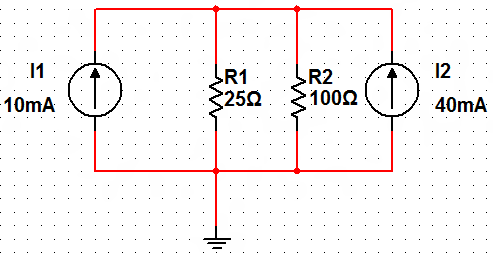
The first thing I did is create a second current source out of the 4 V voltage source and the series resistor R2. I called it I_2.

I_2 = E/R_2 = 4V/100Ω = 40 mA

This gives us:
current_and_voltage_source_2.png


We can combine the parallel current sources I_1 and I_2:

I = I_1 + I_2 = 10 mA + 40 mA = 50 mA
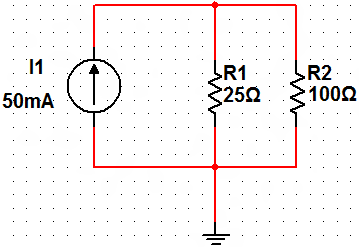
current_and_voltage_source_3.png


By the current divider rule,

I_R2 = (R_T*I)/R2 = (20Ω*50mA)/100Ω = 10 mA

V_R2 = I_R2*R2 = 10mA * 100Ω = 1 V

However, when I run a simulation of the original circuit using MultiSim, I get 3 V through R2. Where am I going wrong?
 
Physics news on Phys.org
JJBladester said:
What is the voltage across R2? You should convert the 4 V source and resistor into a current source as your first step.

current_and_voltage_source.png


The first thing I did is create a second current source out of the 4 V voltage source and the series resistor R2. I called it I_2.

I_2 = E/R_2 = 4V/100Ω = 40 mA

This gives us:

current_and_voltage_source_2.png


We can combine the parallel current sources I_1 and I_2:

I = I_1 + I_2 = 10 mA + 40 mA = 50 mA

current_and_voltage_source_3.png


By the current divider rule,

I_R2 = (R_T*I)/R2 = (20Ω*50mA)/100Ω = 10 mA

V_R2 = I_R2*R2 = 10mA * 100Ω = 1 V

However, when I run a simulation of the original circuit using MultiSim, I get 3 V through R2. Where am I going wrong?
If you get 3 V across R2 in the original circuit, that means that there voltage dropped across R1 in the original circuit is 1 V, which makes sense.

The difficulty appears to be that you are assuming the resistor, R2 in the original circuit has the same voltage across it as the resistor, R2, in the last two circuits.
 
I'm stuck. I think I understand what you mean that R2 in the new (simplified) circuit cannot be treated the same as R2 in the original circuit. Am I correct up to the point where I found a combined 50 mA current source acting on two parallel resistors R1 and R2?

If so, how do I get back to finding the voltage for R2 in the original circuit.
 
JJBladester said:
I'm stuck. I think I understand what you mean that R2 in the new (simplified) circuit cannot be treated the same as R2 in the original circuit. Am I correct up to the point where I found a combined 50 mA current source acting on two parallel resistors R1 and R2?

If so, how do I get back to finding the voltage for R2 in the original circuit.

Find the voltage across R1 in the simplified circuit. It hasn't been changed. Then use that to find the voltage across R2 in the original circuit.
 
JJBladester said:
We can combine the parallel current sources I_1 and I_2:

I = I_1 + I_2 = 10 mA + 40 mA = 50 mA ✔[/size][/color]

By the current divider rule,

I_R2 = (R_T*I)/R2 = (20Ω*50mA)/100Ω = 10 mA
[strike]There are two mistakes in this line, yet you end up with 10 mA and that's the right answer[/strike]https://www.physicsforums.com/images/icons/icon4.gif
Oops, my mistake. What you are using is not what I think of as current divider rule, but it's okay.
 
Last edited by a moderator:
SammyS said:
Find the voltage across R1 in the simplified circuit. It hasn't been changed. Then use that to find the voltage across R2 in the original circuit.

So I can't use the "new" R2 even though it is the same R2 as before?

Anyway, using your advice to find the voltage across R1 in the simplified circuit, I've found the voltage across R2 using Kirchhoff's Voltage Law on the original circuit:

kvl.jpg


Using the current divider rule:

I_{R1}=\frac{(20\Omega )(.05 A)}{(25 \Omega )}=.04A

V_{R1}=\left (I_{R1} \right )\left (R_1 \right )=\left ( .04A \right )\left (25\Omega \right )=1V

E - VR2 - VR1 = 0
VR2 = E - VR1 = 4V - 1V = 3V
 
The book claims the answer is that all the magnitudes are the same because "the gravitational force on the penguin is the same". I'm having trouble understanding this. I thought the buoyant force was equal to the weight of the fluid displaced. Weight depends on mass which depends on density. Therefore, due to the differing densities the buoyant force will be different in each case? Is this incorrect?

Similar threads

  • · Replies 16 ·
Replies
16
Views
2K
Replies
4
Views
1K
Replies
7
Views
1K
  • · Replies 2 ·
Replies
2
Views
2K
Replies
1
Views
1K
Replies
10
Views
3K
  • · Replies 2 ·
Replies
2
Views
1K
Replies
5
Views
2K
  • · Replies 60 ·
3
Replies
60
Views
10K
  • · Replies 6 ·
Replies
6
Views
3K