Gunter_ZA
- 2
- 0
Thread moved from the technical forums, so no Homework Help Template is shown
I am doing a review for a Dynamics exam, but I am having trouble with this one question (below).
Please note the top of the picture contains the answers.
What I have done is make a free body diagram that includes the tension of the cable and the weight of the rider/swing. So according to my calculations for part i:
T= mg cos (30) = 680N
The tangential acceleration is 0
Which according to the provided solutions is incorrect. Am I missing a force?
I figured the tension is integral to finding the velocity of the rider. So I want to get my tension right before I proceed with finding the velocity, though I am also having trouble figuring out how to relate tension and velocity of the acceleration of the rider is 0
I would appreciate an explanation so I can understand.
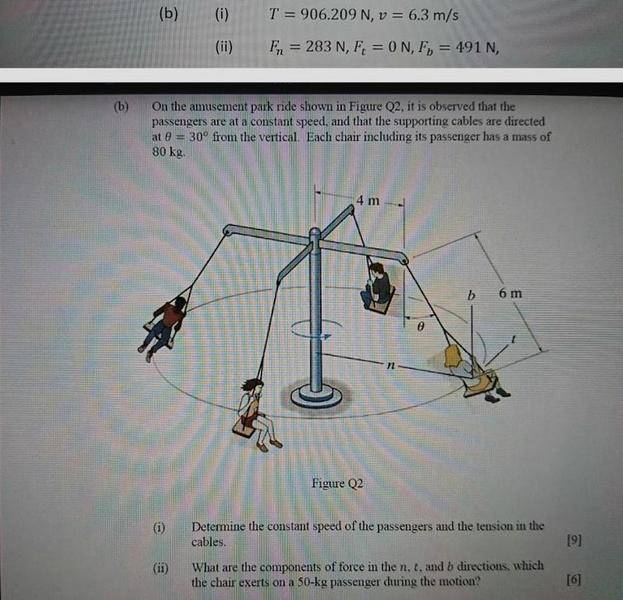
Please note the top of the picture contains the answers.
What I have done is make a free body diagram that includes the tension of the cable and the weight of the rider/swing. So according to my calculations for part i:
T= mg cos (30) = 680N
The tangential acceleration is 0
Which according to the provided solutions is incorrect. Am I missing a force?
I figured the tension is integral to finding the velocity of the rider. So I want to get my tension right before I proceed with finding the velocity, though I am also having trouble figuring out how to relate tension and velocity of the acceleration of the rider is 0
I would appreciate an explanation so I can understand.
