Finding the current in Field winding

Click For Summary
The discussion revolves around calculating the current in field windings of a circuit with two voltage sources. Initial calculations for the effective resistance and current were incorrect, leading to confusion. The correct approach involves determining the voltage across the field resistance and calculating the current through it. After adjustments, the final current through the field winding is found to be 1.13 A, with the back emf calculated at 98.2 V. The mechanical power output is subsequently determined to be 361 W.
Physicslearner500039
Messages
124
Reaction score
6
Homework Statement
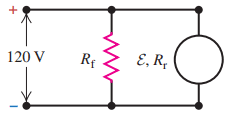
In a shunt-wound dc motor with the field coils and rotor connected in parallel, the resistance Rf of the field coils is 106 Ohm and the resistance Rr of the rotor is 5.9 Ohm. When a potential difference of 120 V is applied to the brushes and the motor is running at full speed delivering mechanical power, the current supplied to it is 4.82 A. (a) What is the current in the field coils? (b) What is the current in the rotor? (c) What is the induced emf developed by the motor? (d) How much mechanical power is developed by this motor?
Relevant Equations
V = E + IR.
The problem seems to be easy but i don't get the correct answer.
1596989935768.png

a. The current in the field coils. The net resistance of Rf = 106 and Rr = 5.9 is
## Reff = \frac {(106 * 5.9)} {(106.9 + 5.9)} = 5.54 ##
## \frac { 120 - E} {5.9} = 4.82 => E = 91.562 ##
## If = \frac { 120 - 91.562} {106} = 0.268 A##
The answer does not match. Please advise.
 
Physics news on Phys.org
Your Reff is irrelevant. There are two voltage sources present in the circuit i.e. the supply voltage and the back emf.
As per your circuit diagram, what is the voltage across Rf? Then what is the current through Rf?
 
  • Like
Likes Physicslearner500039
Ok Understood, Thank You
##If = \frac {120} {106} = 1.13A ##
##Ir = 4.82-1.13 = 3.68A ##
## E = 120-3.68*5.9 = 98.2V##
##Pmech = 98.2*3.68 = 361 W ##
 
  • Like
Likes cnh1995
The book claims the answer is that all the magnitudes are the same because "the gravitational force on the penguin is the same". I'm having trouble understanding this. I thought the buoyant force was equal to the weight of the fluid displaced. Weight depends on mass which depends on density. Therefore, due to the differing densities the buoyant force will be different in each case? Is this incorrect?

Similar threads

Replies
7
Views
1K
  • · Replies 5 ·
Replies
5
Views
1K
  • · Replies 5 ·
Replies
5
Views
2K
Replies
1
Views
1K
  • · Replies 10 ·
Replies
10
Views
2K
Replies
13
Views
9K
  • · Replies 2 ·
Replies
2
Views
1K
  • · Replies 1 ·
Replies
1
Views
1K
  • · Replies 25 ·
Replies
25
Views
2K
  • · Replies 15 ·
Replies
15
Views
3K