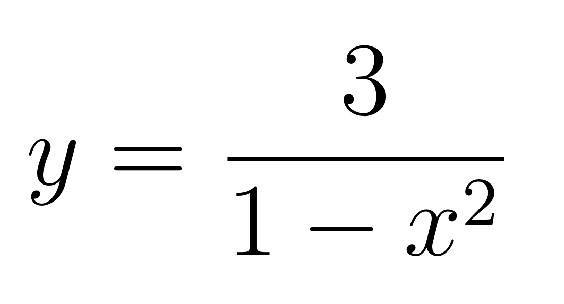
Finding the domain for a rational function.

Join the discussion
Registration is free. Ask a follow-up in this thread, or start your own.
1 reply · 2K views
cavalieregi
Messages
41
Reaction score
0
Hi I have the function
ImageUploadedByPhysics Forums1402359003.204534.jpg


I have worked out the domain as not equal to 1 using the fact the denominator can't equal 0. Now I am stuck finding the range. How would I find it without graphing. The answer is y<0 , y=>3.
 
Physics news on Phys.org
cavalieregi said:
Hi I have the function
View attachment 70478

I have worked out the domain as not equal to 1 using the fact the denominator can't equal 0.
There's one more value of ##x## which must be excluded.
Now I am stuck finding the range. How would I find it without graphing. The answer is y<0 , y=>3.
After excluding ##1-x^2 = 0##, you are left with either ##1 - x^2 < 0## or ##1 - x^2 > 0##. Try writing these inequalities in terms of ##x## instead of ##x^2##.