SUMMARY
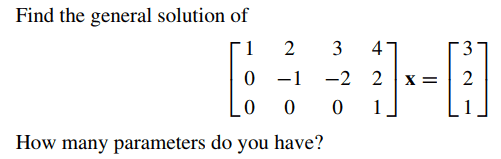
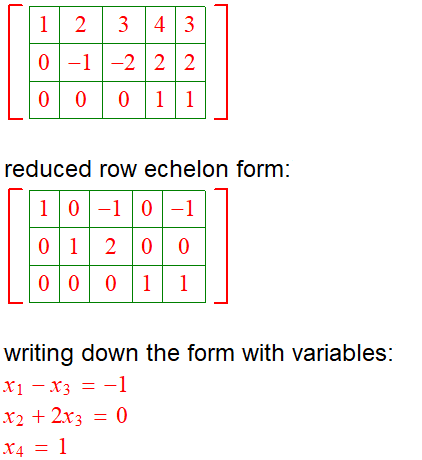
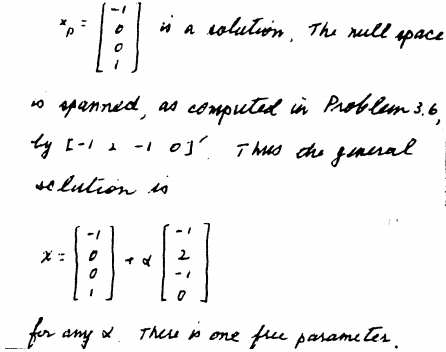
This discussion focuses on finding the general solution of a nonhomogeneous linear system represented by the equation Ax = b. The key points include the use of reduced row echelon form to identify the degree of freedom in the solution, which is determined by the rank of the coefficient matrix and the augmented matrix. The participants clarify that setting x3 = 0 simplifies the solution process, as it is a dependent variable. They also explain the distinction between parameters and variables, emphasizing that only one parameter is needed to describe the general solution due to the presence of one free variable.
PREREQUISITES
- Understanding of linear algebra concepts, specifically nonhomogeneous linear systems.
- Familiarity with reduced row echelon form and its implications for solving systems of equations.
- Knowledge of the relationship between the rank of a matrix and the number of free variables.
- Ability to differentiate between parameters and variables in the context of linear systems.
NEXT STEPS
- Study the method of solving nonhomogeneous linear systems using reduced row echelon form.
- Learn about the implications of rank in linear algebra, particularly in relation to degrees of freedom.
- Explore the concept of homogeneous solutions and how they relate to particular solutions in linear systems.
- Investigate the role of parameters in describing solution sets for linear equations.
USEFUL FOR
Students and educators in mathematics, particularly those focusing on linear algebra, as well as anyone involved in solving or teaching nonhomogeneous linear systems.