Finding the Moment of a Force Using Varignon's Theorem

  • Thread starter Thread starter sevag00
  • Start date Start date
  • Tags Tags
    Direction Moment
Join the discussion
Ask a follow-up here, or get your own question answered by working scientists, mathematicians and engineers — people, not an autocomplete.
Real named experts · corrections over time · the nuance an AI answer skips
8 replies · 3K views
sevag00
Messages
80
Reaction score
1
Hi. I'm really confused in how to find the moment done by force.

I want to find the moment done by the force in this figure.
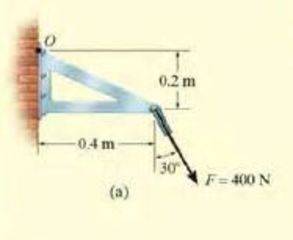
Capture.jpg


The book has resolved the force into its components using principle of moments.
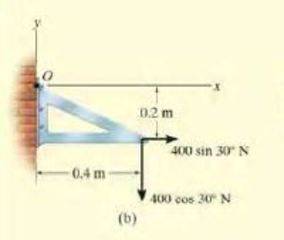
Capture1.jpg


So, how do i find the moments of the components of the force? I know I'm going to use the right hand rule, but i don't know where i am going to put my thumb.
 
on Phys.org
sevag00 said:
Hi. I'm really confused in how to find the moment done by force.

So, how do i find the moments of the components of the force? I know I'm going to use the right hand rule, but i don't know where i am going to put my thumb.

Show your work please.
Anyway,moment =Force x Perpendicular distance
 
I know how to find the magnitude. I'm asking for the direction.
 
sevag00 said:
I know how to find the magnitude. I'm asking for the direction.
If you know it,then show your work.
PF requires one to show his/her work before getting any help(In the homework section):smile:
 
Yeah. But first i should find the direction of the moments of the components of the force so that i get the right result.
 
sevag00 said:
Yeah. But first i should find the direction of the moments of the components of the force so that i get the right result.
You don't need to calculate that.Moment is a turning effect.It does not have any directions.It has direction of rotation.You just have to use common sense and decide whether it's anticlockwise or clockwise
For example,look at this:
attachment.php?attachmentid=64172&stc=1&d=1385061988.gif

Look at diagram a,Force F produces an Anticlockwise moment.
Look at diagram b,Force F now produces a Clockwise moment.

Think about your diagram now
 

Attachments

  • Untitled.gif
    Untitled.gif
    1.6 KB · Views: 588
Okay. But there is something called right hand rule that you indirectly used to find the direction of (a) and (b).
I want to know how the right hand rule is used.
 
I know what your saying. Your taking a direction vector from point O to the line of action of the force. And by using cross product, you're getting the magnitude and direction. But I'm not using that method. I'm using Varignon's theorem.